Measuring heat stress in the workplace
Heat stress in the workplace is no longer a side issue. During warm spells, employees in warehouses, production halls and on building sites are at immediate risk of health complaints and loss of productivity. But when are you, as an employer, obliged to measure heat stress in the workplace? And more importantly: how do you tackle heat stress measurement in practice without unnecessary costs?
In this article you will read:
- when measuring heat stress is mandatory
- how to measure it correctly (and why an ordinary thermometer is not enough)
- what a measurement or measuring system costs
- which solution best suits your situation
or simply give us a call on: 050-5712124
What is heat stress?
Heat stress occurs when the body is insufficiently able to dissipate heat, causing body temperature to rise and health complaints to develop. This is not just about high temperatures, but about the total heat load on the body. That heat load is influenced by several factors, such as:
- air temperature
- humidity
- solar radiation
- air circulation
- physical exertion and workwear
Looking at temperature alone is therefore not enough to assess the risk properly. That is why professional environments use combined measurement methods such as the WBGT index. Heat stress is therefore measured with what is known as a WBGT meter or heat stress meter.
What are the consequences of heat stress for workers?
Heat stress has direct consequences for both the health and the productivity of employees. According to research by TNO, heat stress can lead to:
- reduced concentration and labour productivity
- fatigue and disturbed sleep
- an increased chance of errors and accidents
- dehydration and muscle cramps
- heat exhaustion
- heat stroke (a medical emergency)
In extreme cases heat stress can even lead to hospital admissions or death, certainly among vulnerable groups. Measuring heat stress gives insight into the environment your staff are exposed to.
Which employees are at risk of heat stress?
Heat stress occurs more often than many companies think. According to Arboportaal, an estimated 12% of all companies work in warm conditions. The risk is greatest in sectors where: physical work is carried out, heat sources are present, or work takes place outdoors. Measuring heat stress helps to assess the severity and to take appropriate measures. According to the Social and Economic Council (SER), many employees have to deal with warm conditions, for example in:
- construction and road workers
- landscapers and agricultural workers
- workers in the steel and glass industries
- bakers and production staff
- fire services and emergency services
But heat stress also plays a role in less obvious environments.
- warehouses without cooling
- production halls with machinery
- offices with a lot of solar gain
In offices in particular, direct sunlight can cause extra heat, glare and reduced productivity. In all of these situations, measuring heat stress is a very common solution for assessing and addressing the situation of employees. Heat stress meters are also used to raise active alarms at limit values.
In short: there is no fixed temperature limit at which heat stress is automatically “prohibited”. Even so, as an employer you are indeed obliged to assess and control risks caused by heat.
In Article 6.1 of the Working Conditions Decree, it states:
-
''Taking account of the nature of the work carried out by the employees and the physical load that results from it, the temperature at the workplace shall not cause damage to the health of the employees.''
In other words: employers must do everything they can to prevent health complaints and damage, even though no specific temperatures are stated.
Under the Working Conditions Act you must also:
- map out the risks (RI&E, the Dutch risk inventory and evaluation)
- take appropriate measures, such as PPE, offering cool drinks, working shorter periods with breaks in between, etc.
- demonstrate that the working environment is safe, for example by measuring heat stress
In practice this means you have to start measuring as soon as:
- employees work for long periods at elevated temperatures
- there are complaints about excessively warm working conditions
- physical exertion is involved
- the working environment is poorly ventilated
- heat builds up (in production halls or warehouses, for example)
or simply give us a call on: 050-5712124
How do you measure heat stress in the workplace?
Measuring heat stress goes further than simply measuring the temperature. The actual load on the body is determined by a combination of factors, such as humidity, radiant heat, air movement and physical exertion.
According to European guidelines, heat stress is therefore defined as the total heat load caused by:
- environmental factors (temperature, humidity, sun/radiation, wind)
- physical load (exertion during work)
- personal factors (clothing and protective equipment)
The WBGT measurement: the standard for measuring heat stress
To measure heat stress objectively, professional situations make use of the WBGT index (Wet Bulb Globe Temperature). This method combines several parameters, as set out above, into a single value that you can compare with the Dutch standard. This gives you a realistic picture of how severe the heat actually is for employees.

Measuring heat stress with a WBGT meter
In professional environments, heat stress is measured with a WBGT meter (Wet Bulb Globe Temperature). This type of measuring instrument simultaneously measures several factors that determine how severe heat actually is for the body:
Air temperature + relative humidity + radiant heat + air movement
With a WBGT meter you measure in accordance with international standards such as ISO 7243. This allows you to demonstrate objectively what the risks are, when measures are needed & whether you comply with guidelines within occupational health and safety policy.
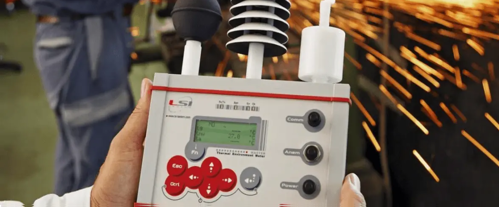
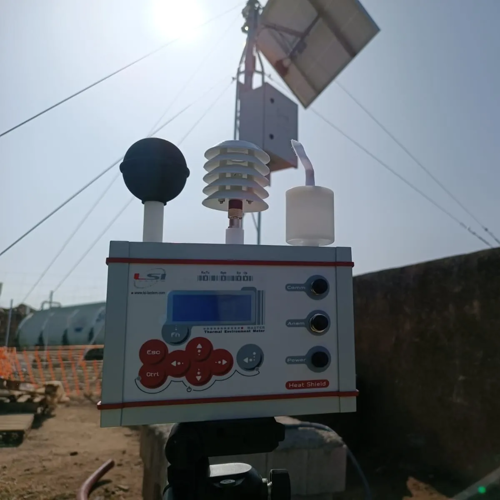
One example of a professional measuring system for heat stress is the LSI Heat Shield WBGT heat stress meter. This type of instrument combines several sensors in one compact and robust system. Among other things, the meter measures:
- dry bulb temperature
- wet bulb temperature
- globe temperature (radiant heat)
- relative humidity
On that basis the system automatically calculates:
- the WBGT index
- the heat index and humidex
- thermal comfort (PMV/PPD)
Want to know more about measuring heat stress?
Still have questions about measuring heat stress? Then take a look at the FAQ right at the bottom of the page!
Would you like to know more about measuring heat stress? Or do you simply have a question? Our experts will be happy to advise you.
Call us directly on 050-5712124, email info@basystemen.nl , or feel free to use the form below.
Because of climate change, the number of warm days and heatwaves in Flanders and the Netherlands is increasing sharply. According to the Flanders Environment Agency the number of heatwave days in Flanders could increase fivefold by 2050 compared with today. A heatwave is defined as a period of at least three days in which:
- the daytime temperature is above 29.6 °C
- and does not fall below 18.2 °C at night
This development means employees are increasingly exposed to prolonged heat, both indoors and outdoors. Measuring heat stress is therefore important in order to prevent your employees becoming less productive and suffering damage to their health.
Many organisations try to assess heat stress on the basis of temperature alone. That is risky. A temperature of 28 °C can, for example:
- be relatively safe in a well-ventilated space
- but become dangerous with high humidity or heavy physical labour
According to European guidelines, the risk depends heavily on:
- the intensity of the work
- the duration of exposure
- the working conditions (indoors/outdoors)
Without a combined measurement you run the risk of underestimating problems or intervening too late. The Labour Inspectorate will not regard that as good employment practice.
Heat stress becomes dangerous when the body can no longer dissipate heat effectively. This can lead to complaints such as dizziness, exhaustion or, in serious cases, heat stroke.
Not only temperature, but also:
- humidity
- solar radiation
- air circulation
- physical exertion
- workwear
Employees who work outdoors, do physically heavy work or work in warm environments such as production halls are at particularly increased risk. Age and health also play a role.
Heat stress is the total load caused by heat. Heat stroke is a serious and acute medical situation in which the body can no longer regulate its temperature.
Through measures such as adjusted working hours, extra breaks, sufficient drinking water, ventilation and monitoring of working conditions.
Heat stress can manifest itself in various ways, depending on the severity of the load. Initially the signs are often subtle, but with continued exposure serious health problems can develop. The most common forms of heat stress are:
- Heat rash (mild form)
This is the mildest form of heat stress. Prolonged sweating blocks the sweat glands, which leads to small blisters on the skin. Complaints: itching, a burning sensation, skin irritation - Heat cramps
Painful muscle cramps, usually in the legs or abdomen. These are caused by the loss of fluid and salt through excessive sweating. Complaints: sudden cramps, muscle pain, fatigue - Heat exhaustion
With prolonged exertion in warm conditions, the body can no longer regulate its temperature and blood circulation properly. Complaints: dizziness, headache, nausea, pallor, unsteadiness/weakness. After stopping work someone may suddenly feel unwell because of a drop in blood pressure. - Heat stroke (a medical emergency)
This is the most serious form of heat stress. Body temperature can rise above 41 °C and the body can no longer cool itself. Symptoms: red, hot and dry skin (or, conversely, extreme sweating), confused behaviour or aggression, convulsions, loss of consciousness. This requires immediate medical assistance.
Besides direct health complaints, heat stress also affects how employees function. On exposure to heat:
- heart rate and body temperature rise
- the ability to concentrate declines (often after just ±1 hour)
- muscles tire more quickly
This leads to:
- lower productivity
- more errors
- an increased chance of workplace accidents
Author: Ivar Bos
Published: April 2026