Detecting compressed air leaks in industry ➟ best measuring equipment in 2026
Compressed air is indispensable for many industrial companies, but at the same time one of the largest hidden cost items. In practice, 20% to 30% of the compressed air generated is often lost through leaks in pipework, couplings and installations. Detecting compressed air leakage at an early stage is therefore a good idea.
The problem: these leaks are usually invisible and often barely audible during production. As a result they go unnoticed for a long time, causing unnecessarily high energy costs and reduced efficiency.
Detecting compressed air leakage is therefore not a one-off exercise, but an important part of preventive maintenance and energy management. With the right measuring equipment, leaks can be located quickly and accurately, without having to shut down production processes.
In this article you will read:
- What does a compressed air leak cost?
- Where do leaks arise in industrial environments?
- Which methods are available to detect compressed air leakage?
- What is the best measuring equipment to detect a gas leak?
or simply call us on: 050-5712124
What does a compressed air leak cost in practice?
Compressed air leaks often seem small, but their impact on energy costs is large. According to the Netherlands Enterprise Agency (RVO), industrial compressed air systems lose 10% to 35% of total consumption through leaks. That means a considerable share of the compressed air generated is never used and is therefore pure waste, while the cost of producing it is still paid.
Compressed air = an expensive energy source
What many companies underestimate: compressed air is one of the least efficient forms of energy in industry.
- Only about 5% of the energy used for it is effectively put to the purpose it was intended for.
- The rest is largely lost as heat
In addition, 70–75% of the total cost of a compressed air system consists of energy consumption. In other words: every leak translates directly into higher energy costs.
Important: this loss occurs 24/7, including outside production hours.
Would you like to know what a compressed air leak is costing you? Work it out with the online calculator from our partner CRYSOUND:
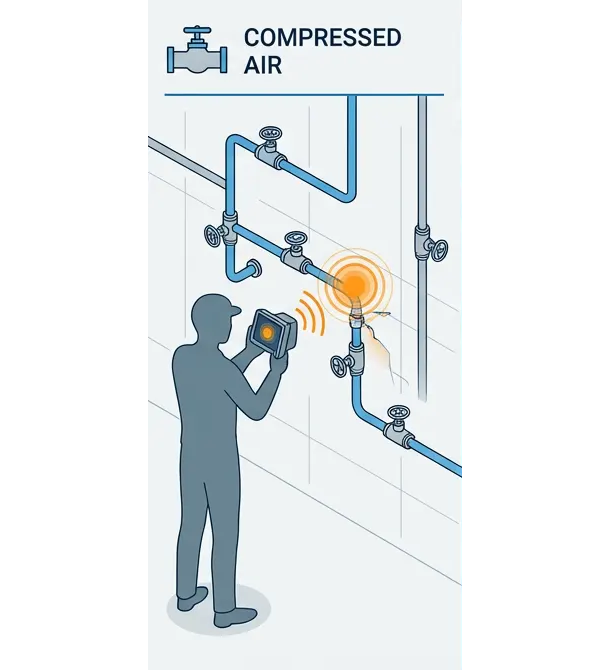
Impact on installation and production
According to the American efficiency department, leaks not only cause energy loss, but also:
- pressure loss in the system
- poorer equipment performance
- higher wear and maintenance costs
In other words: leaks affect not only your costs, but also your reliability and production efficiency. Detecting a compressed air leak at an early stage is therefore a smart move.
The cost of buying or hiring a gas leak detector is quickly recovered. On top of that you also improve employee safety and score better on sustainability. Below we explain the various methods for taking compressed air leak detection into your own hands.
How do you detect compressed air leakage? (methods compared)
There are several ways to detect compressed air leaks in industrial installations. The choice of method depends on the size of the system, the complexity of the installation and the level of accuracy required.
In practice, the following methods are used most often:
- Acoustic cameras
- Ultrasonic leak detection
- Simple visual inspection
1. Detecting compressed air leakage with an acoustic camera
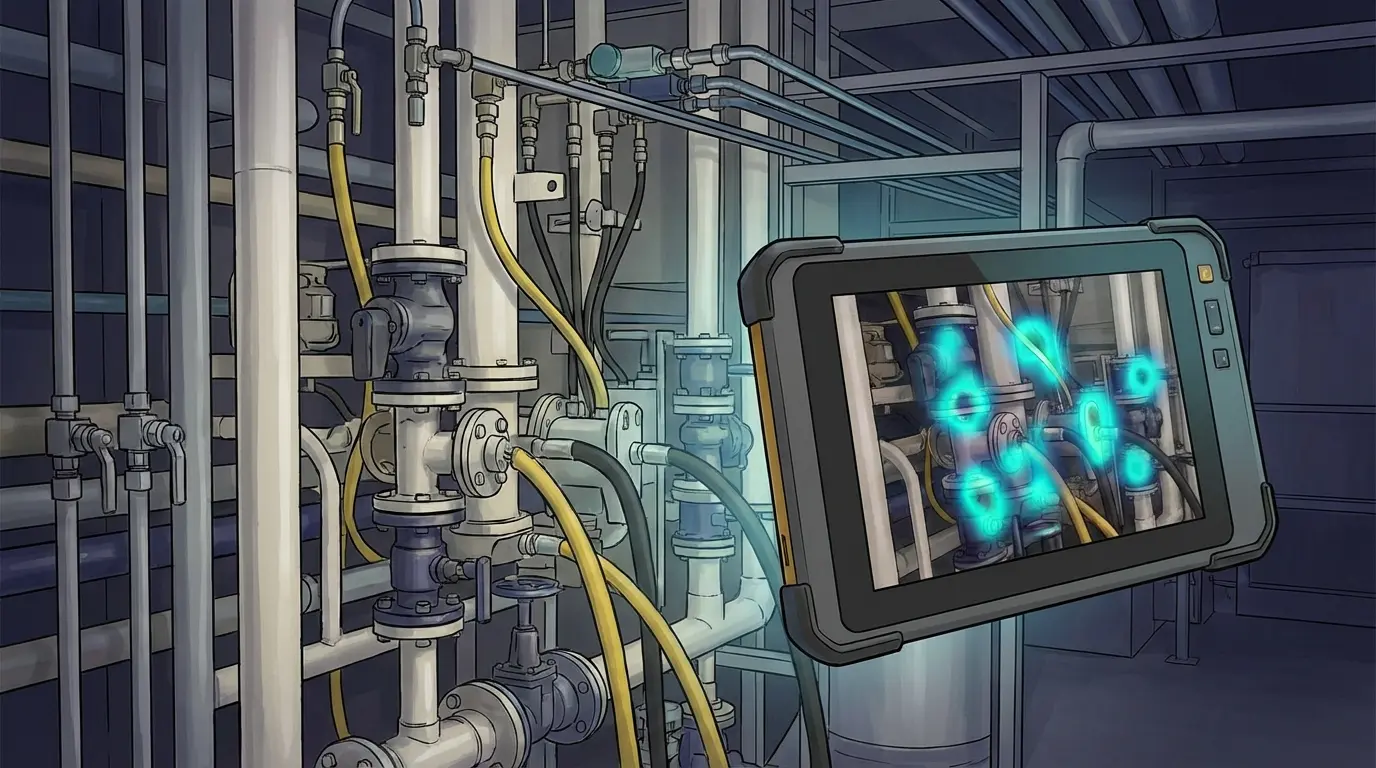
The latest generation of measuring equipment uses acoustic cameras. This technology visualises sound and makes compressed air leaks immediately visible on a screen. Instead of listening at a single point, you see at a glance where the leak is, even from a distance. An acoustic camera combines a microphone array (dozens of microphones in a circle or pattern) with an optical camera. While the microphones measure sound pressure from different directions, the camera determines exactly where the sound is coming from and projects it in real time onto a display as a "heatmap of sound". A widely used acoustic camera is, for example, the CRY2620.
Advantages:
- leaks immediately visible (including small leaks)
- works from a distance, without stopping production
- scans large installations very quickly
- easy to record and report on
Disadvantages:
- higher investment than simple measuring aids
For industrial applications this is the most efficient and most accurate method.
2. Detecting compressed air leakage with ultrasonic leak detection
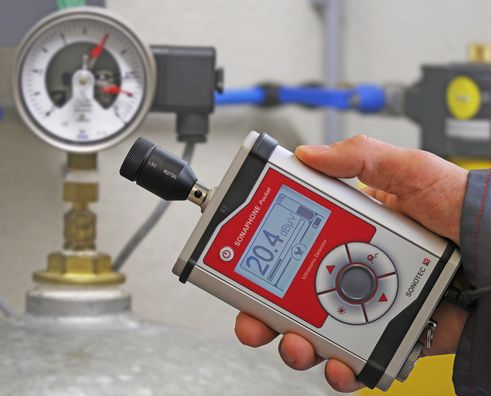
Ultrasonic detectors convert high-frequency sounds (which the human ear cannot hear) into audible signals. This makes leaks easier to trace than with the naked ear, because ultrasonic leak detectors pick up compressed air leaks both in the audible range and in the ultrasonic range.
Before acoustic cameras were available, an ultrasonic leak detector such as the Sonaphone Pocket was the most advanced choice for detecting gas leaks.
At the time this was recommended by the US government, see fact sheet 3 (page 28). Today an acoustic camera is the best on the market, with more functionality.
Effective, but less suitable for fast, large-scale inspections.
Advantages:
- detects smaller leaks
- relatively affordable
- mobile in use
Disadvantages:
- point measurement (you have to walk the whole system manually)
- time-consuming on large installations
- hard to visualise or report on
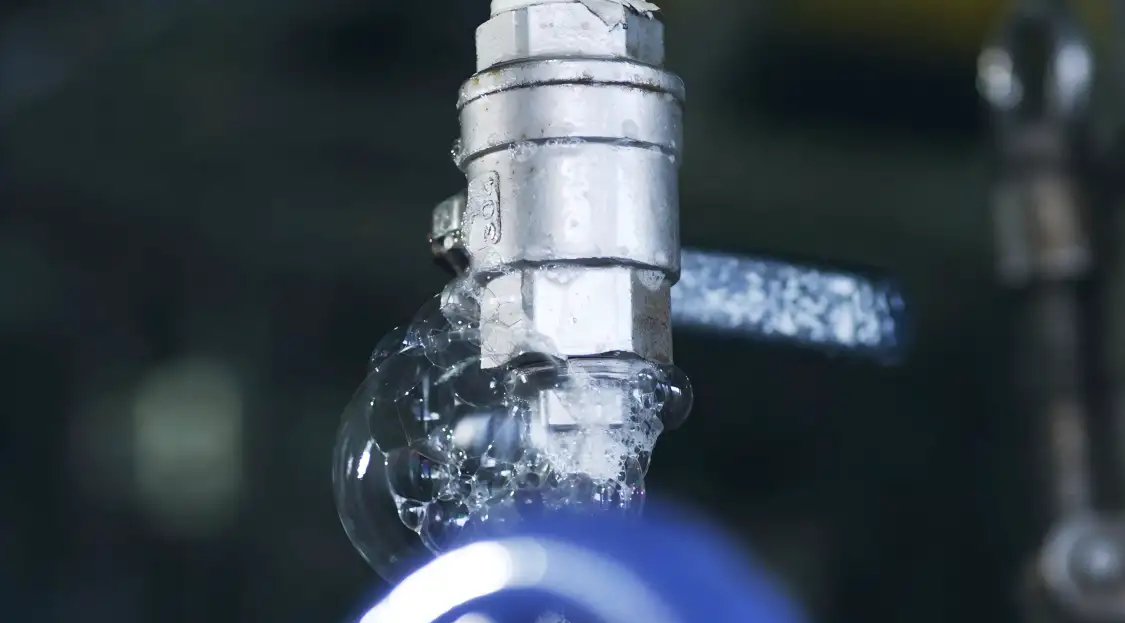
3. Detecting compressed air leakage by visual inspection and listening
The simplest and most widely used method of detecting compressed air leaks is to use a leak detection fluid, often a soap solution. This is applied to pipework, couplings and connections.
Where a leak is present, bubbles visibly form at the point where compressed air is escaping.
This method is mainly used for targeted checks, but is unsuitable for a complete and efficient inspection of industrial installations.
Advantages:
- simple and inexpensive compressed air leak detection
- immediately visible result on larger leaks
- no specialist equipment needed
Disadvantages:
- only applicable to accessible parts of the installation
- time-consuming on large systems
- in many cases not suitable while production is running
- small leaks are difficult to detect
- no measurement data or reporting possible
Best measuring equipment for detecting compressed air leakage in 2026
The choice of measuring equipment depends strongly on the size of the installation and how often leaks occur. In practice we see a clear shift: companies are moving away from manual inspections and increasingly choosing faster and more reliable measuring methods for detecting compressed air leakage.
There are several models of acoustic camera on the market, which can be divided into two categories:
- Portable acoustic cameras
Portable models are used for on-site inspections. They can be deployed flexibly and are ideal for periodic checks within an installation.
- CRYSOUND POCKET → Entry-level acoustic camera model
- CRY8124 → Advanced high-resolution acoustic camera
-CRY8125 ATEX → Explosion-proof (ATEX/IS) acoustic camera
- CRY2626G → Drone-mounted acoustic camera - Stationary acoustic cameras
Stationary systems are permanently installed and continuously monitor a specific zone or installation. These systems automatically detect deviations and can signal immediately when new leaks develop.
- CRY2623M Stationary → Permanent acoustic camera for continuous monitoring
The image below shows schematically which acoustic camera is suitable for which application.

Source: Crysound
From cost to action: detecting compressed air leakage in practice
Calculating losses is the first step, but it only delivers value once you turn it into action. In many industrial environments it turns out that detecting compressed air leakage is needed not only to save costs, but also for:
- stable pressure in installations
- less wear on compressors
- higher energy efficiency
Modern measuring methods such as acoustic imaging make it possible to locate leaks quickly and precisely and to fix them straight away.
That turns compressed air leak detection from a periodic check into a structural part of energy management.
Want to know more about detecting compressed air leakage?
Would you like to know more about detecting compressed air leakage, or are you unsure which measuring method best suits your installation? Have a look at the FAQ further down this page for practical answers.
Is your question not listed? Our specialists will be glad to give you tailored advice on detecting compressed air leaks and choosing the right measuring solution for your situation.
Feel free to contact us via:
- 📞 050-5712124
- 📧 info@basystemen.nl
- 📩 or use the contact form below
Because energy is the largest cost item within compressed air systems, detecting leaks almost always delivers immediate results. In many industrial situations, fixing leaks means:
- directly lower energy costs
- less load on compressors
- longer service life of installations
Detecting compressed air leakage is therefore not an optimisation, but one of the fastest ways to save costs.
A sound level meter only measures the noise level at a single point. So you know how loud it is, but not where the sound is coming from.
An acoustic camera, by contrast, shows both the location and the intensity of sounds, which makes it far more suitable for applications such as detecting compressed air leakage in industrial installations.
The detection range depends on factors such as leak size, ambient noise and the number of microphones.
In practice:
- a leak of ±1 mm → detectable at 10 to 30 metres
- larger leaks → at even greater distances
This means compressed air leak detection can be carried out without entering the installation itself.
Yes. Modern systems use advanced beamforming technology to isolate specific sound sources, even in environments with a lot of background noise. The more microphones, the better:
- higher accuracy
- better filtering of noise
This makes it possible to detect compressed air leaks without stopping production.
The basics are simple: you point the camera and immediately see where the sound is coming from. In practice:
- basic use → learned within a few minutes
- advanced analysis → requires experience and training
For standard compressed air leak detection the learning curve is short, but deeper analysis calls for experience.
For compressed air leakage the payback period is usually a matter of months.
A single leak of around 6 mm (¼ inch) can already:
- cost €2,500 to €8,000 a year
Many installations contain dozens to hundreds of leaks, so the investment often pays for itself at the very first inspection. Systematic compressed air leak detection therefore delivers direct savings quickly.
Yes. Every pressurised gas flow that causes turbulence produces sound. That is why acoustic cameras can detect leaks of, among others:
- compressed air
- nitrogen
- oxygen
- hydrogen
- natural gas and refrigerants
The detection principle stays the same, only the frequencies differ.
A cost estimate is an indication and not an exact audit.
Its purpose is to determine whether compressed air leak detection should be given priority within your maintenance policy.
If you have no data, 20% is a realistic benchmark.
Both the U.S. Department of Energy and ENERGY STAR indicate that this is a common level of loss in systems where compressed air leak detection is not yet carried out structurally.
Because a calculation does not show where the problem is. Without compressed air leak detection, leaks remain and costs keep coming back.
Above all in complex industrial installations where leaks are hard to find with manual methods. Here, detecting compressed air leakage with acoustic cameras is the fastest and most effective approach.
Author: Ivar Bos
Published: April 2026