Measuring ammonia is important whenever there is an ammonia odour, possible exposure to NH3 or risks in a working environment. Gas detection or air measurements can be used to establish the concentration of ammonia in the air. On this page you can read how measuring ammonia works, what risks ammonia poses and which measuring methods are available.
All about measuring ammonia / NH3 measurement
Ammonia (NH3) is a common chemical substance used across a wide range of industries, including refrigeration systems, agriculture, chemical production and cleaning products. Although it has many applications, exposure to high concentrations of ammonia can pose serious health risks. This informative article is a practical guide for occupational hygienists, safety experts and other professionals who want to know more about measuring ammonia / NH3 measurement in order to protect employees from the hazards of ammonia in the workplace. The article is structured as follows:
- What is ammonia?
- Applications of ammonia
- Hazards of ammonia
- What does occupational health and safety law say about measuring ammonia?
- Occupational exposure limit for ammonia
- Measuring ammonia using gas detection
- 3 widely used gas detectors for NH3 measurement
What is ammonia?
Ammonia is a colourless gas with a pungent odour and is often used because of its alkaline properties. The gas also occurs in nature and is produced, for example, by bacteria during the process of ammonification, in which organic nitrogen material (such as dead plants and animals) is broken down into ammonia. Although ammonia occurs naturally, the concentrations are usually low and are quickly converted into other nitrogen compounds by microbial activity in soil and water. In industry, however, it often occurs in higher concentrations, which makes measuring ammonia necessary.
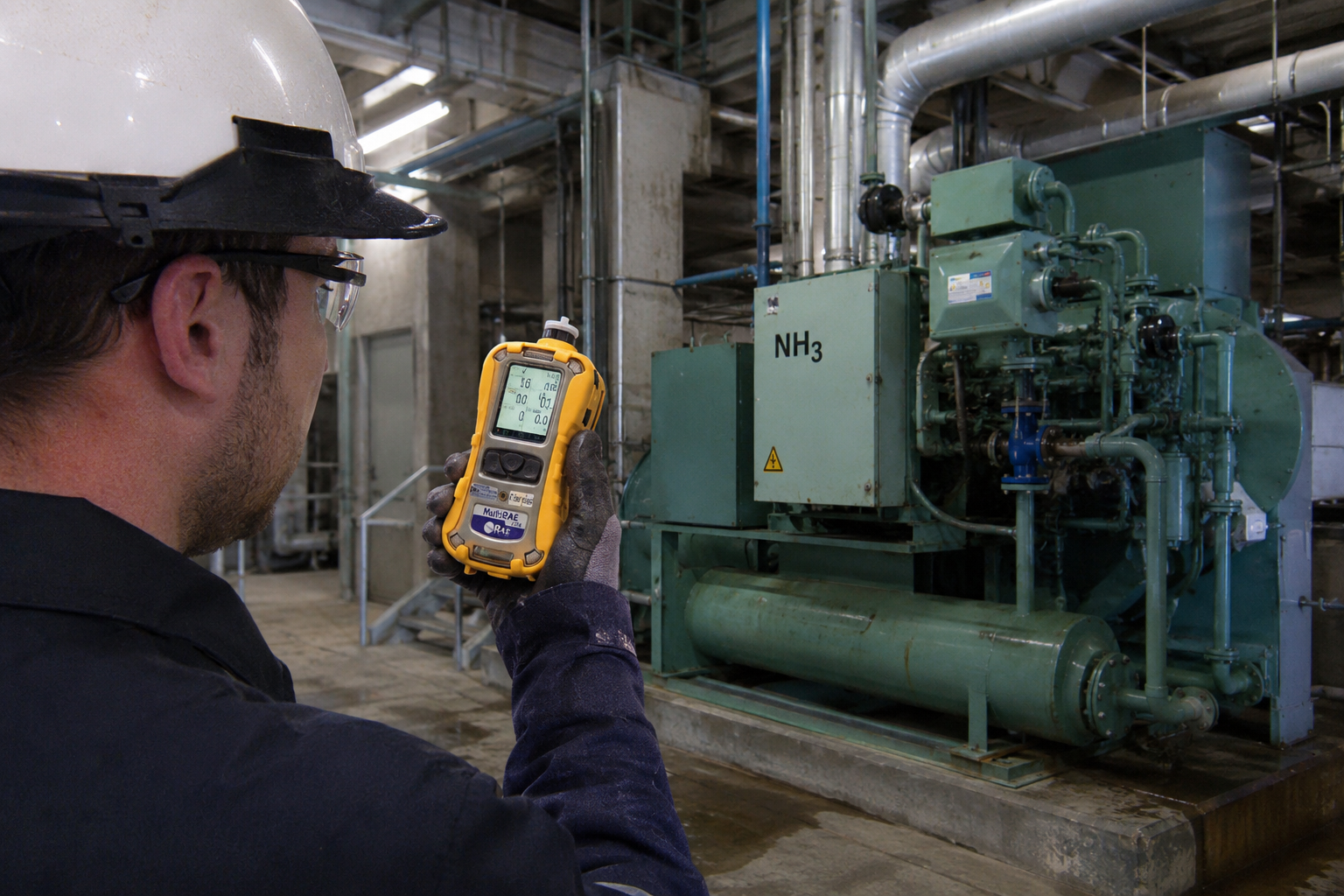
Measuring ammonia means determining the concentration of ammonia (NH₃) in the air using gas detection equipment. This is done to prevent health risks, to monitor exposure and to comply with safety and occupational health and safety legislation. Measurements can be taken either with portable equipment or continuously (fixed installations), depending on the situation.
Applications of ammonia
Ammonia gas (NH3) is used on a large scale in various industries because of its versatility. Some important applications are:
-
Refrigeration systems: Ammonia is widely used as a refrigerant in industrial refrigeration systems, particularly in the food processing and storage industries. It is preferred over synthetic refrigerants because of its efficiency and environmental friendliness. Another widely used alternative refrigerant is CO2, which brings its own risks.
-
Fertilisers: Ammonia is an important raw material for the production of fertilisers such as urea and ammonium nitrate. These are widely used in agriculture to feed crops and increase yields.
-
Chemical industry: Ammonia is an important raw material for the production of various chemicals, such as nitric acid and ammonium sulphate.
-
Cleaning products: Ammonia is used in household and industrial cleaning products because of its ability to dissolve grease and dirt.
Hazards of ammonia
Why is measuring ammonia important?
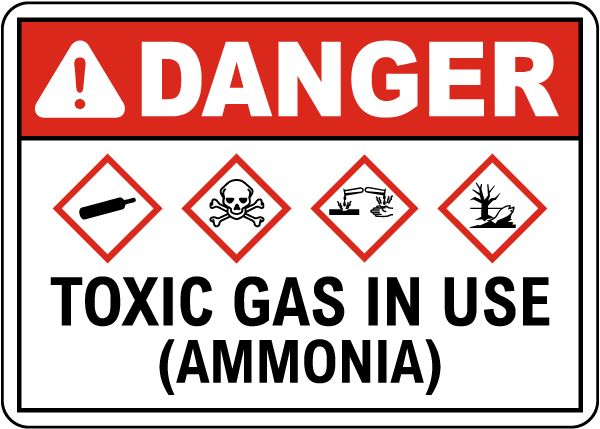
Measuring ammonia is important because exposure to ammonia can be harmful to health. It can lead to irritation of the eyes and airways, breathing problems and, at high concentrations, even life-threatening situations. By measuring ammonia, risks can be identified and controlled in good time.
source: Antigifcentrum
Hazards of ammonia
Why is measuring ammonia important?
Measuring ammonia is important because exposure to ammonia can be harmful to health. It can lead to irritation of the eyes and airways, breathing problems and, at high concentrations, even life-threatening situations. By measuring ammonia, risks can be identified and controlled in good time.
source: Antigifcentrum
What does occupational health and safety law say about ammonia?
The Dutch Working Conditions Act (Arbowet) states that employers are responsible for providing a safe and healthy working environment. This includes the duty to protect employees against the hazards of exposure to dangerous substances, including ammonia. Employers must carry out a comprehensive risk inventory and evaluation (RI&E) in order to assess the risks of exposure to dangerous substances, and also to measure flammable substances such as ammonia. So you measure ammonia in order to reduce exposure and the risk of explosion.
The Working Conditions Act states in article 3, paragraph 1 that the employer must take effective measures in the field of fire fighting. Article 6 of the Act states that, where very large quantities of flammable substances are present, the employer must carry out a supplementary risk inventory and evaluation (ARIE).
Employers must also take measures to minimise exposure to ammonia. This can be done through technical, organisational and personal protective measures. Examples are improving ventilation, using extraction systems, and providing personal protective equipment such as gas masks and safety goggles. Proper information and training of employees is important as well: they must be well informed and trained about the risks of ammonia and the correct procedures for working safely. Measuring ammonia is an obvious choice here, in order to map the risks and choose a well-considered approach.
For ammonia, according to the List of Statutory Occupational Exposure Limits in Annex XIII of the Dutch Working Conditions Regulations, the 8-hour time-weighted average for ammonia is 20 ppm (=14 mg/m3). In addition, the 15-minute short-term exposure limit has been set at 50 ppm (=36 mg/m3) for exposure of no more than 15 minutes. These limit values are usually set automatically in your gas detector. Measuring ammonia with a gas detector is therefore very simple. You wear the device on your work clothing, and it goes into alarm automatically when the sensor detects ammonia.
Measuring ammonia using gas detection
How can you measure ammonia?
You can measure ammonia in several ways:
- portable gas detectors (personal safety)
- fixed measuring systems (continuous monitoring)
- detector tubes for a quick indication
The right method depends on the risk, the environment and whether continuous monitoring is required.
As the Dutch Working Conditions Decree prescribes, providing personal protective equipment such as gas detection is the employer's responsibility. This is something BaSystemen can advise you on and supply, both for purchase and for rental. At BaSystemen we are not tied to a single manufacturer, which means we can offer the most suitable model for your application. In principle we can measure ammonia in a wide range of situations. Ammonia often occurs together with other gases, for example when we talk about manure gases. You can read more about manure gases in this article: Manure gases – modern solutions for working with them more safely. In that case you may need to measure ammonia in combination with other sensors in a multi-gas detector. If you know that, for example, there is only a hazard from ammonia near your refrigeration system and not from other gases, you can measure ammonia with a personal single-gas detector, or a fixed gas detection installation. Finally, for temporary situations it is possible to work with a movable area monitor.

Multi-gas detector with pump
With the WatchGas POLI you can measure ammonia while also monitoring other gases. This detector supports up to four sensors simultaneously, so that a gas detector can be configured with sensors for ammonia, oxygen, carbon monoxide, hydrogen sulphide and explosive gases (methane, for example).

Personal single-gas ammonia detector
With this single-gas detector you can only measure ammonia. No other sensors are built into this device. One advantage of this is that the gas detector is smaller and lighter, and can be attached to your work clothing so that it alerts you during your work if there is ammonia gas in the air. In addition to measuring ammonia, the ToxiRAE Pro can also store the measurement data in its internal memory. That way you can also analyse measured concentrations using the software. Of course this device also shows the real-time concentrations on the display and raises the alarm when the exposure limits are exceeded.

Fixed NH3 detector
Besides portable gas detection, it is also possible to measure ammonia with a fixed transmitter. These are usually installed at couplings or other leak-prone locations in a process containing ammonia. As soon as one or more of these detectors detect ammonia, this is communicated via a 4-20 mA signal to a controller, PLC or another receiver that can process the signal into an action, such as triggering an alarm or shutting down a machine.
Want to know more about measuring ammonia?
Would you like to know more about measuring ammonia, or which measuring solution is suitable for your working environment? Then take a look at the FAQ further down this page for answers to frequently asked questions.
Is your situation not among them? Our specialists will be happy to help you with tailored advice on measuring ammonia, legislation and regulations and the right detection solutions.
Please feel free to contact us via:
- 📞 050-5712124
- 📧 info@basystemen.nl
- 📩 or use the contact form below
Ammonia (NH₃) is a colourless gas with a strong, pungent odour that is widely used in industry and agriculture.
Measuring ammonia is important because exposure can be harmful to health even at relatively low concentrations and can lead to irritation of the eyes, skin and airways.
You need to measure ammonia whenever there is a risk of exposure, for example in:
- refrigeration systems (refrigeration engineering)
- agriculture and livestock farming
- the chemical industry
- storage and transport of ammonia
Employers are obliged to assess and control exposure in accordance with the applicable occupational health and safety legislation.
There are various methods for measuring ammonia, depending on the application:
- Portable gas detectors → for personal safety
- Fixed detection systems → for continuous monitoring
- Detector tubes → for quick indicative measurements
The choice depends on whether you measure occasionally or want to monitor continuously.
Statutory occupational exposure limits apply to measuring ammonia in the workplace.
In the Netherlands the statutory limit value is around:
- TWA (8 hours): 20 ppm
- 15-minute STEL: 50 ppm
It is important always to follow the current guidelines within your sector.
For professional ammonia measurement the usual choice is:
- portable gas detection (personal protection)
- fixed gas detection systems (area monitoring)
In high-risk environments, continuous monitoring is often mandatory or strongly recommended.
How often you need to measure ammonia depends on the risks:
- continuous risk → permanent monitoring
- occasional risk → periodic measurements
This is usually laid down in the RI&E (Risk Inventory & Evaluation).
Insufficient ammonia measurement can lead to:
- irritation of the eyes and airways
- breathing problems
- chemical burns at high concentrations
- in extreme cases, life-threatening situations
Rapid detection is crucial in order to prevent damage.
There are two main solutions for measuring ammonia:
- portable → protects the employee
- fixed → monitors the environment continuously (area monitoring)
In many situations a combination is used for maximum safety.
The accuracy of ammonia measurement depends on:
- the type of sensor
- calibration
- environmental factors
A resolution of 0.1 ppm or 1 ppm is certainly achievable, and more than sufficient to measure against the exposure limit guidelines.
Regular maintenance and calibration are essential for reliable measurements.
Continuous ammonia measurement is needed when:
- there is a permanent risk of leaks
- large quantities of ammonia are being handled
- safety and compliance are crucial
This is often the case in industrial installations and refrigeration engineering.
Author: Ivar Bos
Last updated: May 2026