Measuring hydrogen sulphide (measuring H2S) in 2026 – risks, limit values and the right measuring equipment
That typical smell of rotten eggs.
Many people know it from the sewer, a manure pit or a biogas plant. What fewer people know is that this sulphur gas is officially called hydrogen sulphide. H2S for short.
And that it can be life-threatening.
Precisely because you can smell it, many people think they are safe as long as they smell nothing. That is a misconception. At higher concentrations olfactory fatigue sets in. The smell disappears while the gas is still present. That makes measuring H2S treacherous, certainly in confined spaces such as pits, tanks and cellars.
Measuring hydrogen sulphide is therefore not a formality. It is a very important part of working safely in sectors such as sewer management, water treatment, petrochemicals and biogas. Moreover, the Dutch limit value is low. Only 2.3 mg/m³ as an 8-hour TWA. That calls for reliable and properly calibrated gas detection.
In this article you will read what hydrogen sulphide actually is, why it is so dangerous and how to measure H2S professionally and in line with legislation in 2026.
or feel free to call us on: 050-5712124
What is hydrogen sulphide?
Hydrogen sulphide, also called sulphuretted hydrogen, is a colourless gas with the characteristic smell of rotten eggs. The chemical formula is H₂S. The CAS number is 7783-06-4.
It is heavier than air. As a result it sinks to low points such as pits, cellars and tanks. The gas is flammable and can form explosive mixtures with air.
H2S occurs naturally. In volcanic areas, marshland, or in standing water. But also in industrial processes.
An important characteristic is that it can be smelled at very low concentrations. The odour threshold is around 0.13 ppm. That seems safe. But at higher concentrations olfactory fatigue sets in. You then no longer smell it, while it is still present. That is why measuring H2S with a gas detector is so important.
Where does hydrogen sulphide occur and how is it formed?
H2S is a putrefaction gas.
It is formed when organic material breaks down in an oxygen-poor environment. We call that anaerobic conditions. Think of manure cellars, sewage sludge, digestion tanks or standing water.
Organic material to think of includes: manure and slurry, sewage sludge, food residues, plant waste, paper pulp, animal remains, biological residual streams in digesters, organically polluted surface water. All these materials contain carbon compounds that micro-organisms use as an energy source.
And sulphate is an oxidised form of sulphur. Chemically: SO₄²⁻.
It occurs naturally in: groundwater, seawater, soils, manure, industrial waste water and sulphur-bearing minerals In water treatment plants and sewer systems sulphate is therefore almost always present. That forms the basis for H2S formation. And that is the gas we measure when we measure hydrogen sulphide.
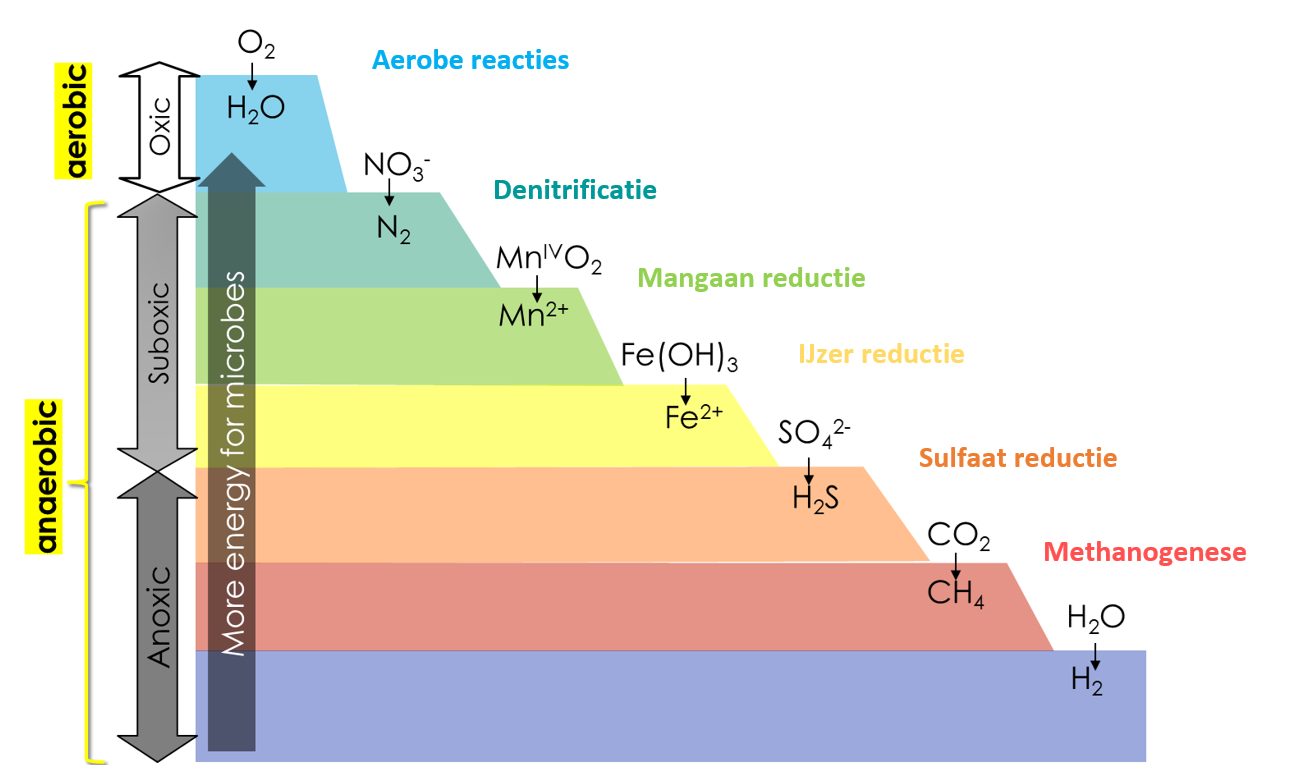
In an oxygen-poor environment bacteria switch to electron acceptors other than oxygen. You can see that in the so-called redox ladder in the image below. Formation takes place through microbial processes. Sulphate-reducing bacteria use sulphate as an electron acceptor. In doing so they convert sulphate into sulphide. This is a redox reaction. The end product is hydrogen sulphide gas.
That is why you often see H2S together with methane. Methane is formed by methanogenic micro-organisms in the same anaerobic environment. Both gases are released during digestion, putrefaction and biological breakdown. But as you can see, methanogenesis sits lower on the redox ladder than sulphate reduction. That means micro-organisms such as bacteria gain more energy when they reduce sulphate. So: as long as sulphate is present, sulphate reduction will be energetically more favourable than methanogenesis. In other words: only once the sulphate has run out does methane formation increase sharply. That is why in many systems you first see H2S formation and then dominant methane production. And measuring H2S can be done perfectly well with an electrochemical sensor, whereas we measure methane with an LEL sensor.
Typical locations where H2S (and therefore also methane) is released:
- Sewage pumping stations
- Water treatment plants
- Manure storage
- Biogas plants
- Oil and gas extraction
- Refineries
- Tank storage
Because the gas is heavier than air, it can accumulate at working height in confined spaces. That makes measurement beforehand and during the work crucial.
H2S is toxic.
Methane is explosive.
Together they form a combination of asphyxiation hazard, poisoning and explosion risk. For the reasons above, hydrogen sulphide is also best measured at various heights. It may well be that at the opening of a sewer low values are measured at the top. However, the further down you climb, the higher the readings rise, because it is a heavy gas. Measuring H2S is therefore not simply a matter of wearing a device and getting on with the job.
Is hydrogen sulphide dangerous?
Yes. Hydrogen sulphide is one of the most dangerous gases encountered in industry and in confined spaces. Hydrogen sulphide is toxic and can even be fatal. The gas can catch you out before you realise it is there. On top of that, H₂S is measured a great deal because it is a common gas, which makes it even more dangerous.
The danger lies in three things at once:
- H2S is toxic
- H2S can switch off your sense of smell
- H2S can form explosive mixtures
1. Toxic action of H2S (= poisoning)
H2S can disrupt your body. At low concentrations it stings your eyes, you smell rotten eggs and you get a headache. H2S can block respiration. It stops your cells from being able to use oxygen. That works like a kind of internal asphyxiation.
This is because H2S disrupts cellular respiration. It inhibits enzymes in the mitochondria, including cytochrome oxidase. As a result cells can no longer use oxygen, even though there is enough oxygen present in the air.
Target organs are:
- Eyes
- Airways
- Nervous system
- Heart
- Brain
2. Effects at rising concentrations
At higher concentrations the smell disappears, but the gas is still there. You can become dizzy, nauseous, or even lose consciousness.
At low concentrations <10 ppm:
- Eye irritation
- Throat irritation
- Headache
Around 10 ppm:
- Strong smell
- Possible irritation
- Loss of concentration
Above roughly 100 ppm:
- Olfactory fatigue -> the smell disappears, but the gas is still there! The danger is no longer perceived. Fortunately a gas detector is still able to measure the hydrogen sulphide, whatever the concentration.
High concentrations
- Unconsciousness
Respiratory arrest
Possibly fatal within minutes
Several fatal accidents are known in manure cellars, sewer pits and tanks where employees entered a space without gas measurement.
3. Fire and explosion hazard
H2S is flammable.
In combination with methane an explosive mixture can arise.
Ignition can occur through sparking or static electricity.
Why smell is not a safety indicator
The rotten egg smell is treacherous. At higher concentrations olfactory (= sense of smell) paralysis sets in. You no longer smell anything. But the gas is still present. That is why relying on smell is not a safety strategy. Only measuring hydrogen sulphide gives certainty. And even then you still have to go about it properly in order to work safely with H2S. Such as measuring H2S at various heights.
Source: Health Council of the Netherlands advisory report Hydrogen sulphide
Dutch limit value for H2S
In the Netherlands clear rules apply to exposure to hydrogen sulphide. The aim is to protect employees against the harmful effects of H2S, both in the long and the short term.
Time-weighted average (TWA-8 hours)
The maximum average exposure over an 8-hour working day is 2.3 mg/m³ (~1.6 ppm). Do you work for longer periods in a manure cellar, sewer, tank or at a waste water plant? Then you must not exceed this limit. A gas detector will not only measure hydrogen sulphide on the basis of acutely dangerous concentrations. The device will also alarm when you have been exposed to too high a daily quantity.
Short-term exposure (STEL)
For short peaks there is a guide value of approximately 10 ppm (14 mg/m³) over 15 minutes. Higher concentrations can be dangerous or fatal within minutes. Every gas detector will measure a STEL for H2S, so that you know whether you have had too high an exposure over the last 15 minutes.
Why measuring is mandatory
Because H₂S can deceive the nose, smelling is not a safety strategy. The gas can accumulate low down near the ground or in confined spaces. Only a reliable gas meter gives certainty where measuring H2S is concerned .
Practical points for employers and field workers regarding H₂S
- Always check the air before entering a pit, cellar or tank. Hydrogen sulphide can in fact also be measured with a pumped gas detector. That way you can know the H2S concentration before you enter a space.
- Use personal H2S detectors.
- Document the measurements for the Dutch Working Conditions Act and internal safety.
Tip: for temporary work or occasional checks it is handy to rent an H2S detector. That way you have professional measuring equipment available without any investment, and you meet all statutory requirements. In many cases a standard 4-gas detector such as the Riken Keiki GX-3R is the best choice. That way you are immediately protected against methane (CH4), oxygen (O2), and explosion hazard (LEL). Measuring H2S with a pump? Then you can opt for an additional Riken Keiki RP-3R, or for example a WatchGas POLI.
The best measuring equipment for measuring H2S
Measuring hydrogen sulphide calls for reliable gas detection.
Whether you carry out short checks or want to monitor all working day, the right detector makes the difference between working safely and taking risks. Below are three strong options for professional H2S measurement.

WatchGas SST1 – Single-gas detector for H₂S
The WatchGas SST1 is a robust single-gas detector, specially designed for measuring hydrogen sulphide. It focuses on one goal: continuous H₂S measurement. That makes it ideal for farmers, sewer work, manure pits or other situations where H₂S poses the greatest risk. The SST1 is light and compact. You simply attach it to your clothing or overalls. It has a clear display with a real-time H₂S reading and audible/visual alarms when the set thresholds are exceeded. Thanks to accurate sensors it can also reliably measure low H₂S concentrations . Also ideal for anyone who wants to rent an H₂S detector for task-specific or spot checks of hydrogen sulphide, without unnecessary extra sensors.

Blackline G6 – Smart gas detector with 4G‑alerting
The Blackline G6 is much more than a portable gas alarm. Of course it can measure H₂S and it gives audible and visual alarms. But the real advantage lies in the cloud connectivity: as soon as an alarm goes off, your colleagues see remotely and immediately:
- The H₂S concentration at that moment
- Whether a breathing mask is needed during the rescue operation
- The exact location of the employee thanks to built-in GPS
This is vital in acute situations, for example if someone loses consciousness in a cellar or tank. In addition the G6 automatically keeps track of all measurement data, including peak concentrations and log data.

GX‑3R - H₂S, CH₄, O₂ and LEL in one
The Riken Keiki GX‑3R is an all‑in‑one 4‑gas detector and, as well as measuring hydrogen sulphide, can also measure methane (CH₄), oxygen (O₂) and explosive vapours (LEL). This device is ideal for workplaces where several gas risks can occur at the same time. As you have read, H₂S as a putrefaction gas often occurs together with CH4. With the GX‑3R you can measure H₂S and at the same time check whether there is methane or an oxygen deficiency, or whether an explosion hazard is lurking. This not only increases safety, it also avoids the need for several devices. And the big advantage: this device is barely larger than a single-gas detector! Perfect if you want to rent an H₂S detector and immediately have full gas monitoring capability for field work or project locations.
Want to know more about gas detection?
Any further questions about measuring hydrogen sulphide? Then take a look at the FAQ right at the bottom of the page!
Would you like to know more about buying or renting a professional gas detector? Our experts will be happy to give you tailored advice!
Request advice without obligation below or call us directly on 050-5712124.
📞 Call us or 📧 email info@basystemen.nl
Or use the form below!