Best monitors 2026 + buying guide

Measuring particulate matter in the workplace

Measuring particulate matter: everything you need to know for a safe working environment

In modern working environments, controlling particulate matter and measuring it are crucial to the health and safety of employees. Particulate matter, made up of tiny particles suspended in the air, can come from a variety of sources and can cause serious health problems after prolonged exposure. This article covers the most important aspects of particulate matter in detail:

  • What is particulate matter? 
  • Possible sources of particulate matter
  • What the Dutch Working Conditions Act says about particulate matter
  • The best equipment for measuring particulate matter

What is particulate matter?

Particulate matter, also known as PM, refers to tiny particles in the air that vary in size, from ultrafine particles (smaller than 0.1 micrometre) to larger particles (up to 10 micrometres). Particulate matter is a collective term for all airborne particles smaller than ten micrometres. By way of comparison: a single human hair is more than five times thicker! Particulate matter is divided into different sizes: the most common are PM10, PM4, PM2.5, PM1 and PM0.1.

Sources of particulate matter in the workplace

Particulate matter has always occurred in nature and can come from natural sources such as sea salt, pollen and volcanoes. However, since the rise of industrial processes, many human sources have been added. Common human sources of particulate matter are: 

  • Combustion processes

    • Traffic: Vehicles running on fossil fuels such as petrol or diesel emit particulate matter as a by-product of combustion. This includes particles such as soot (elemental carbon) released by incomplete combustion of fuel in the engine. Heavy vehicles such as lorries and buses often contribute significantly to particulate matter levels in urban areas.

    • Industrial combustion: Industrial processes such as power generation, steel production, cement production and waste incineration can produce large quantities of particulate matter. These processes often involve burning fossil fuels or other materials that release particles into the air.

    • Heating systems: Heating systems that run on fossil fuels, such as wood burners, coal stoves or old diesel-fired heating installations, can also emit particulate matter into the air as a result of burning these fuels.


  • Mechanical activities: 
    Mechanical operations such as grinding, sanding, sawing and milling can produce particulate matter by releasing small particles from the material being worked. In factories, for example, this can result in wood dust, metal dust or other particulate matter. 

  • Demolition work:
    Demolishing buildings or structures releases large quantities of dust and particulate matter, particularly when concrete, brick, plasterboard or other materials are broken down. This can be released from the material being worked on, but can also simply be blown up by the wind.


Identifying these sources is the first step towards effective control of particulate matter in the workplace.

Hazards of particulate matter

The lower the number, the smaller the dust particles and the deeper they can penetrate into your lungs and cause damage. The smallest particulate matter (ultrafine particles) even enters your bloodstream and can cause cardiovascular disease. Soot and ultrafine particles are the most harmful. But other hazardous substances that also fall under the umbrella term particulate matter are allergens, welding fumes, diesel engine emissions, wood dust, nanoparticles, quartz dust, chromium-6 and more.

Exposure to particulate matter can cause serious health problems, particularly for the respiratory tract and the cardiovascular system. The particles can penetrate deep into the lungs and lead to breathing difficulties, worsening of asthma, bronchitis, lung cancer and cardiovascular disease. Employees who are regularly exposed to particulate matter run an increased risk of these conditions, especially in sectors such as construction, metalworking, mining and agriculture.

Source: Longfonds

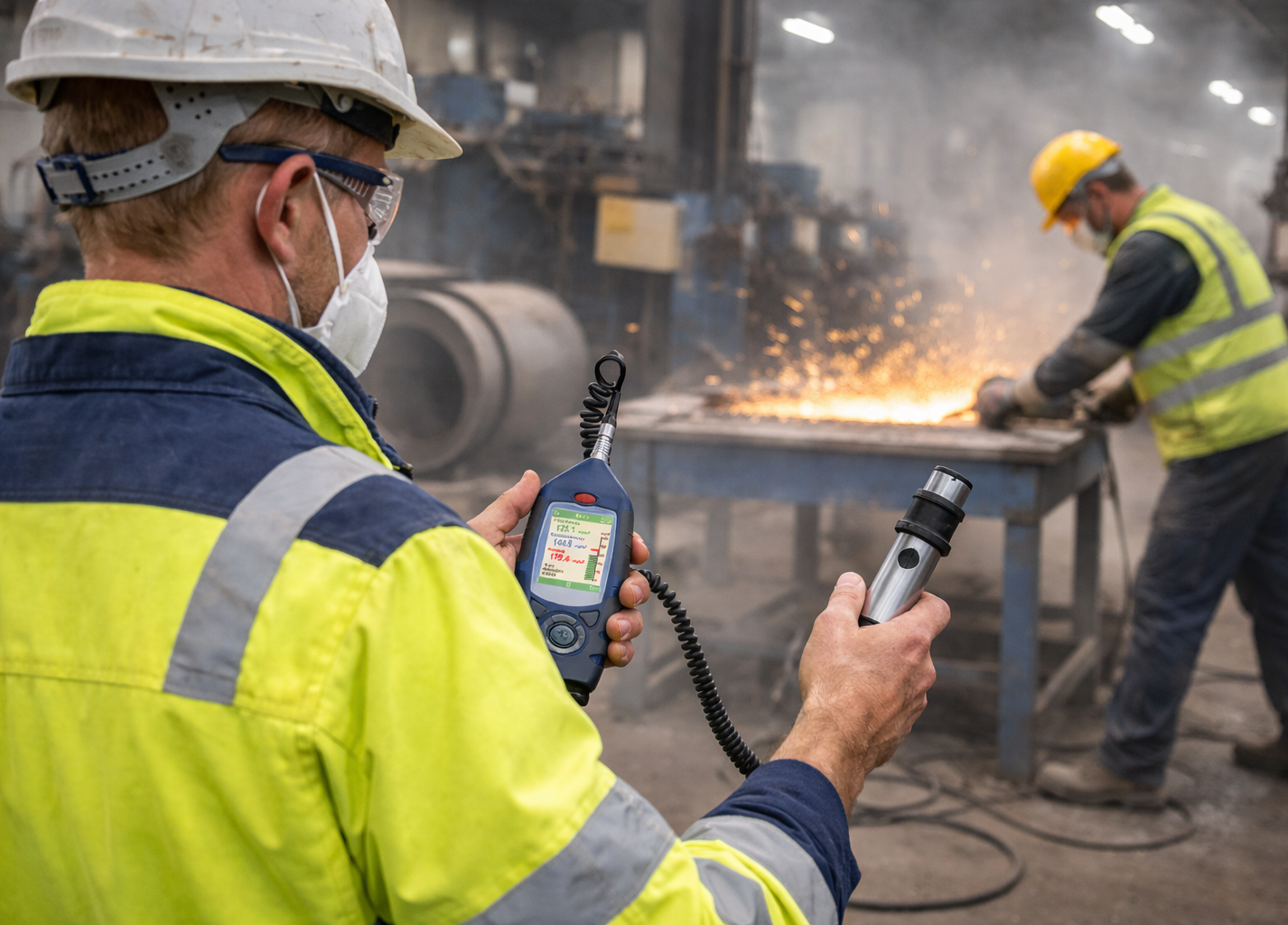
Basystemen Blogs Fijnstof Meten Op De Werkplaats Slijpen Afbeelding (1)

Legislation and guidelines on particulate matter

First of all, it is important to determine which particulate matter we are talking about. As mentioned earlier, a distinction can be made between particulate matter in outdoor air and particulate matter in the workplace.

Particulate matter in outdoor air

Very important where particulate matter is concerned is EU Directive 2008/50/EC. But take note! This concerns the quality of outdoor air (think of particulate matter emissions around Schiphol). Among other things, this EU directive sets limit values for the concentrations of both PM10 and PM2.5. For PM10 an annual average of 40 µg/m3 has been set, and a 24-hour average of 50 µg/m3 which may be exceeded no more than 35 times a year. For PM2.5 an annual average of 25 µg/m3 applies. In addition to the limit values for particulate matter, EU Directive 2008/50/EC also sets limit values for nitrogen oxides (NO and NO2). If you are interested in measuring particulate matter or monitoring nitrogen oxides in accordance with the European directive on outdoor air quality, take a look at the Casella Guardian2

Particulate matter in the workplace

The Dutch Working Conditions Act (Arbowet) imposes clear obligations on employers to protect staff against  exposure to particulate matter in the workplace. Under the Working Conditions Act, the employer is responsible for identifying and evaluating the risks of exposure to particulate matter and for taking appropriate measures to control those risks. This includes implementing technical and organisational measures to prevent or minimise exposure to particulate matter, such as the use of extraction systems, ventilation, wet methods for dust control, and providing personal protective equipment such as respiratory protection. In addition, the Working Conditions Act requires employers to provide employees with information and instructions about the risks of particulate matter and the correct measures they must take to protect themselves. A sound risk inventory and evaluation (RI&E) starts with measuring particulate matter.

So in summary:

  • Risk analysis: Employers must evaluate the risks of exposure to particulate matter and take appropriate measures.
  • Control measures: Implement technical and organisational measures to reduce exposure to particulate matter, such as extraction systems, ventilation, the use of personal protective equipment, and working methods that minimise dust emissions.
  • Monitoring and inspection: Carry out regular air quality measurements and inspect equipment to ensure effective control of particulate matter.

Measuring equipment for particulate matter

Which particulate matter monitor do you need?  Selection guide:


Using suitable measuring equipment is essential for measuring particulate matter and taking preventive measures. Some commonly used measuring instruments are:

Type of instrument Application Description
Handheld dust monitor Quick measurements at various locations These dust monitors are hand-held and are ideal for monitoring different workplaces within a short space of time. This makes it easy to build up a picture of where in your company exposure to dust occurs.
Personal dust monitor Measuring individual exposure

Personal dust monitors are worn on the person during (part of) the working day and map the total exposure to dust that an employee experiences in a day. A useful tool for checking against the exposure limit value.

Transportable dust monitor Temporary monitoring at a single location A transportable dust monitor can be set up for a longer period to measure dust levels at a location. Measuring particulate matter with a transportable dust monitor is perfect for temporary area monitoring or, for example, fenceline monitoring.
Fixed dust monitor Continuous monitoring of fixed locations A fixed dust monitor is actually installed and wired at a location in order to monitor dust over a long period. Measuring particulate matter with a fixed monitor is useful at locations where there is a periodic chance of high dust levels. The fixed dust monitor can raise an alarm when levels are too high, so that staff are notified
Gravimetric equipment Accurate analysis via a laboratory Alongside digital measuring methods, particulate matter can also be measured using gravimetric filters and an air sampling pump. With this method, an air sampling pump is attached to an employee's work clothing, drawing air through a gravimetric filter. Over the course of the day this filter collects the particulate matter to which the employee is exposed.


So in summary: 

Which particulate matter monitor do you need?


Best measuring equipment for particulate matter in 2026


A personal dust monitor such as the XD1+ is compact and easy to use, giving users immediate insight into the levels of various particles, such as (particulate) dust and pollen. This helps to reveal exposure to potentially hazardous dust concentrations on the shop floor. The XD1+ raises an alarm when limit values are exceeded, but can also be used purely as a data logger, whose measurement data can be read out at the end of the day for further analysis. That way you know immediately at which moments exposure is highest and action can be taken.


Microdust Pro 2 - Handheld monitor

The Microdust Pro 2 is an advanced handheld monitor designed to measure dust particles in the air. The Microdust measures total dust (TSP) and can therefore also measure particulate matter. This device provides real-time measurements, giving immediate knowledge of air quality. This means risks of exposure to harmful particles can be identified and addressed quickly. In addition, the Microdust Pro 2 is portable, so several locations can be analysed within a short space of time. It is highly suitable for source tracing of particulate matter, for example. It can equally be used to measure particulate matter periodically and to compare values before and after a change.


Guardian2 - Transportable dust monitor

The Casella Guardian2 is an advanced transportable dust monitor that can be installed on mains power or a solar panel to measure particulate matter semi-permanently. This device enables real-time monitoring of dust levels in the air, allowing immediate intervention in the event of increased exposure to hazardous particles. In cases where the limit value for dust levels is exceeded, you receive a text message or e-mail, so you are informed straight away. The Guardian 2 weighs around 13 kg and is therefore reasonably easy to move, which makes it ideal for professionals working in environments with potentially harmful dust particles, such as construction sites or factories. In addition, this dust monitor can even be equipped with a noise, VOC or vibration sensor, so you can monitor several hazards at the same time.


Apex2 - Air sampling pump

The Apex2 air sampling pump offers an effective solution for collecting air samples in dusty environments. Unlike the digital dust monitors above, which take continuous measurements, the Apex2 can collect samples for later analysis in the laboratory. This makes detailed analyses of air quality over longer periods possible. The pump is portable, robust and easy to operate, which makes it suitable for fieldwork in a wide range of industries. The results of a gravimetric analysis can be compared well against the exposure limit.

Want to know more about measuring particulate matter?

Do you want to measure particulate matter in the workplace, or are you unsure which measuring equipment best suits your situation? In this article you have found the most important information about risks, legislation and measuring methods. Also take a look at the FAQ on this page for practical answers to frequently asked questions.

Still not quite sure? That is understandable, as the right measuring approach depends heavily on your working environment, type of activities and exposure risks.


Please feel free to contact us for tailored advice:

📞 050-5712124
📧 info@basystemen.nl
📩 or use the contact form below
 

Frequently asked questions [FAQ]

Measuring particulate matter means determining the concentration of dust particles (such as PM10 and PM2.5) in the air. This is done with special measuring equipment in order to gain insight into air quality and into employees' exposure in the workplace.

Particulate matter can be measured in the workplace in various ways:

  • With a handheld dust monitor for quick measurements
  • With a personal dust monitor for individual exposure
  • With a fixed or transportable monitor for long-term monitoring
  • With gravimetric measurements for accurate analysis via a laboratory

The right method depends on the purpose of the measurement.

Various standards apply to measuring particulate matter, depending on the situation:

  • European limit values for PM10 and PM2.5 apply to outdoor air
  • In the workplace, exposure limit values under the Working Conditions Act apply

Employers are obliged to measure exposure and to assess whether it remains within the statutory limits.

Measuring particulate matter is important because exposure to dust particles can lead to serious health problems, such as:

  • Respiratory complaints
  • Asthma and bronchitis
  • Cardiovascular disease

By measuring particulate matter, risks can be recognised and addressed in good time.

The choice of particulate matter monitor depends on the application:

  • For quick checks: handheld dust monitor
  • For personal exposure: personal dust monitor
  • For continuous monitoring: fixed or transportable monitor
  • For accurate measurements: gravimetric equipment

It is important to match the measuring method to the working environment and the purpose.

How often you need to measure particulate matter depends on the risks in the workplace. In environments with a lot of dust (such as construction or industry) measurements are often taken continuously or periodically. Under the Working Conditions Act you must in any case measure whenever there are risks of exposure.

The cost of measuring particulate matter varies widely:

  • Simple measurements with handheld monitors are relatively inexpensive
  • Continuous monitoring with fixed systems is more expensive
  • Gravimetric measurements involve costs for laboratory analysis

The total cost depends on the measuring period, the equipment and the accuracy.


In smaller companies, where particulate matter is released only occasionally, renting is an attractive option. For example: 


The Dutch Working Conditions Act (Arbowet) applies to measuring particulate matter in the workplace. It obliges employers to identify and control the risks of exposure to hazardous substances such as particulate matter. This means that in many cases you also have to carry out measurements in order to establish the level of exposure.

Measuring particulate matter is not always explicitly compulsory, but it is indirectly. If the risk inventory and evaluation (RI&E) shows that employees are exposed to dust, you must assess that exposure. In practice this often means that you have to carry out measurements to demonstrate that you remain below the limit values.

For the workplace there are no general limit values for “particulate matter” as a whole, but there are for specific substances such as:

  • respirable dust
  • inhalable dust
  • quartz dust (respirable crystalline silica)

These limit values are laid down in Dutch and European regulations. Measurements are needed to determine whether these limits are being exceeded.


Limit values in the Netherlands: 


Dust Description NL limit value
Wood dust The statutory limit value relates to hardwood dust.
2 mg/m3 inhalable fraction (TWA - 8h)
Flour dust wheat,barley,rye
1.2 mg/m3 (TWA - 8h)
but, target value: 
0.2 mg/m3 (TWA - 8h)
Respirable quartz* quartz, silicon (di)oxide, quartz sand, silica (respirable dust, crystalline)
0.075 mg/m3 respirable fraction (TWA - 8h)
Paper dust Cellulose
No limit value due to insufficient data.
Cotton dust  
0.2 mg/m3 (TWA - 8h)
Coal dust  
2 mg/m3 (TWA - 8h)
Grain dust The Health Council defines grain dust as dust particles originating from, among other things, wheat, oats, barley, rye, maize, rice, pulses (including peas and soya) and various oilseeds. The advice does not relate to dust originating from ground products
1.5 mg/m3 (TWA - 8h)
Soya flour dust  
4 mg/m3 (inhalable flour dust) (TWA - 8h)
Dust (inhalable and respirable)


Please note: historical limit value. It lapsed on 1 January 2007, but is still frequently used in practice. The Health Council has particulate matter on its work programme; until there is new consensus or official advice, it is recommended to take the best substantiated foreign values (such as the German value of 1.25 mg/m³) as a starting point. 


10 mg/m3 inhalable fraction (TWA - 8h)
5 mg/m3 respirable fraction (TWA - 8h)


* Read more about this in our article on measuring quartz dust!

Legislation for outdoor air (such as EU Directive 2008/50/EC) focuses on general air quality and uses limit values for PM10 and PM2.5.

For the workplace the focus is on personal exposure and rules from the Working Conditions Act apply. Here the question is what an employee actually inhales during work.

You demonstrate compliance by:

  • carrying out an up-to-date RI&E
  • taking measurements of particulate matter or dust exposure
  • comparing results against limit values
  • taking appropriate measures where limits are exceeded

Documentation of measurements and measures is essential during inspections.

The labour inspectorate checks whether:

  • risks of dust exposure have been included in the RI&E → very easy to tackle with a handheld dust monitor.
  • measures have been taken to limit exposure
  • measurements have been carried out where necessary
  • employees are properly informed and protected

Where measures are inadequate, this can lead to warnings or fines.

Author: Ivar Bos 
Last updated: April 2026