Legislation and guidelines
As with particulate matter of larger particle sizes, a distinction can be made for ultrafine particles between exposure in the workplace and exposure in outdoor air. Workplace exposure always falls under the Dutch Working Conditions Act (Arbowet), for which the employer is responsible. However, an employer is not responsible for the background exposure to ultrafine particles present in that area.
Ultrafine particle exposure in the workplace
As briefly mentioned, exposure to ultrafine particles in the workplace is the employer's responsibility. There are no public/statutory limit values for ultrafine particles in the Netherlands. FNV and VNO-NCW have published a ‘Guide to working safely with nanomaterials and products ’. The guide is intended as a tool for the risk inventory & evaluation (RI&E) focused on working with nanomaterials. With exposure to ultrafine particles there is the practical problem that the harmfulness/toxicity is not yet well understood. But there are strong indications that exposure leads to harmful effects. They therefore recommend working with the rule of thumb: Risk = Hazard x Exposure
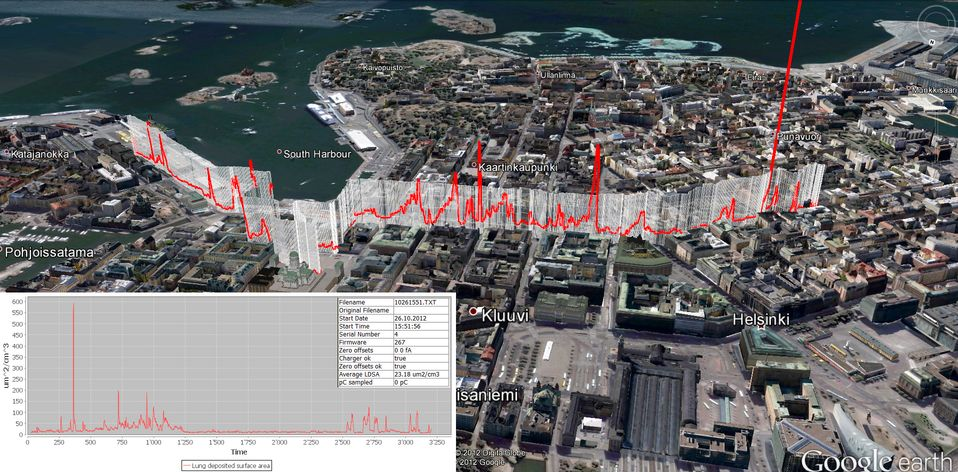
The Naneos Partector 2 calculates the LDSA value and indicates on the screen, using traffic-light colours, which category the exposure falls into (according to the best available knowledge). With regard to the health disadvantages caused by ultrafine particles, this is more accurate than measuring a quantity of dust per unit of air volume (for example: mg/m³), as explained in the next paragraph.
Background exposure in outdoor air
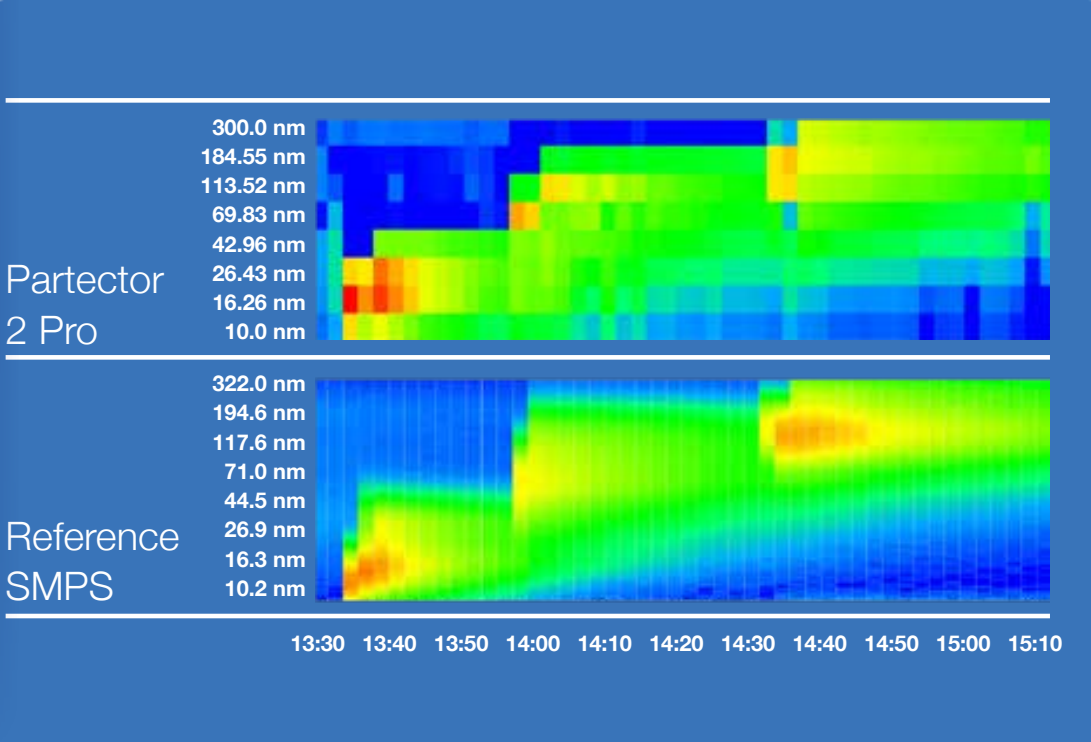
There is (as yet) no (binding) standard for measuring ultrafine particles in outdoor air. Since March 2020, however, there has been a European standard for measuring the particle size distribution (with SMPS) (EN-17434). This standard prescribes how particle sizes between 10 and 800 nm must be measured with a Mobility Particle Size Spectrometer. A new directive that includes ultrafine particles is also under development. In it they are referred to as “one of the unregulated air pollutants of emerging concern”. The proposal in the draft directive is to start measuring UFP at a number of so-called supersites. A decision on the new directive is expected in 2024.
Measuring ultrafine particles
Particulate matter can be measured in various ways. Traditionally the particle mass per unit of air volume is measured, as is the case with PM10, PM2.5 and PM1 for example. Alternative parameters are, for instance, the number of particles, or the surface area of the particles per unit of volume. There is no such thing as the "best" measuring technique to use - it always depends on the application or the question you want to answer.
With regard to the health disadvantages caused by ultrafine particles, it can be argued that the traditional reporting of a quantity of dust per unit of air volume (for example: mg/m³) is not very meaningful. Only the particles that end up in the human body can cause health effects, so that is what should be measured when we measure ultrafine particles. The deposition fraction as a function of particle size for three different regions of our airways is shown in the figure below.
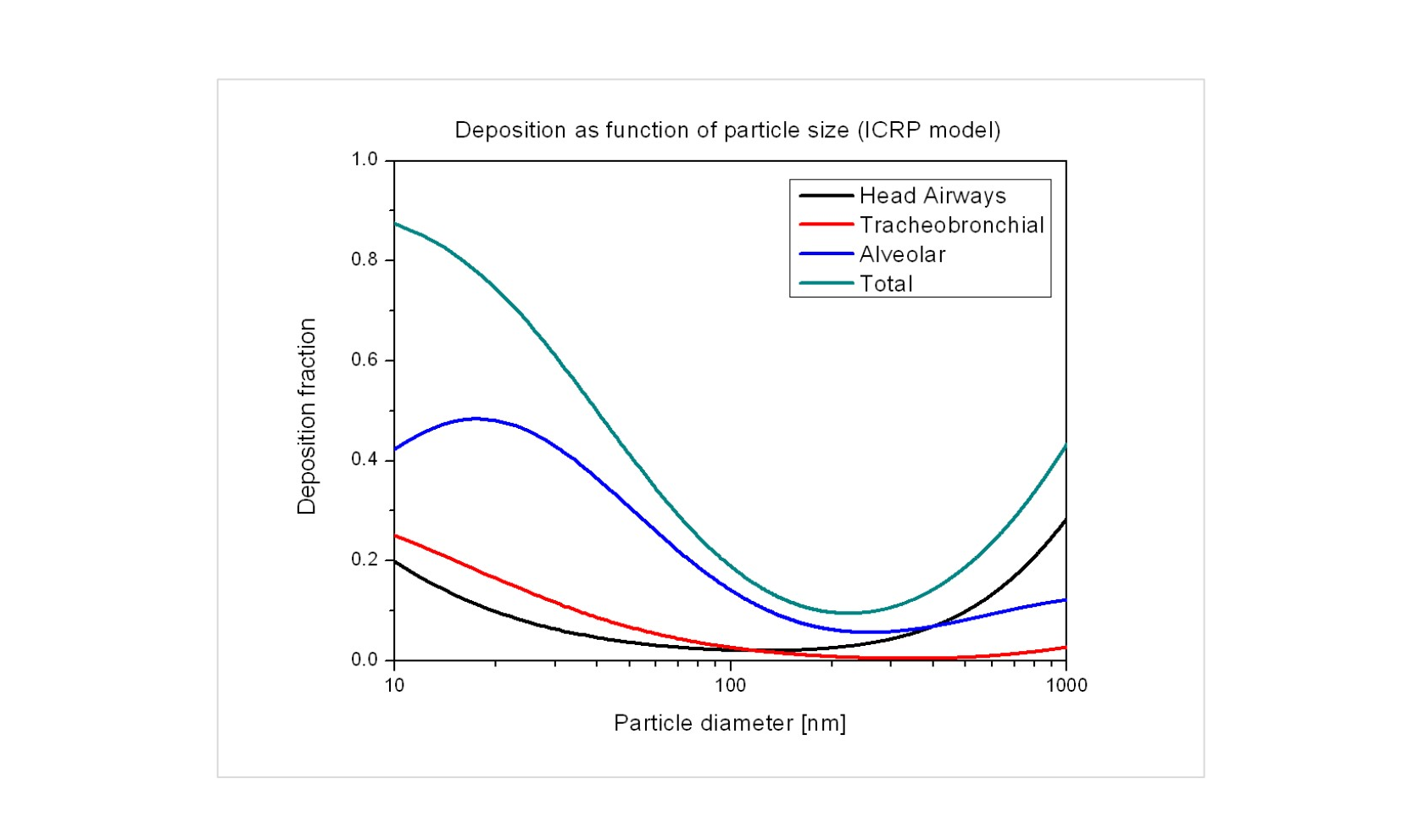
Total deposition shows a clear minimum around 200-300 nm, where only ~10% of the particles present in the air end up in our body, whereas at a diameter of 40 nm roughly half of the particles end up in our body. On a mass basis, a single 200 nm particle (with a density of 1, spherical) is 125x heavier than a comparable 40 nm particle and contributes 125 times more to the measured PMx, although it contributes "only" 20 times more to the mass that ends up in the human body, because its deposition is far less likely. We can therefore conclude that - at least with regard to health effects - we should look only at deposited particles.
Various laboratory studies have shown that, on a mass basis, smaller particles appear to be more toxic than larger particles. This is explained by the larger surface area of the smaller particles; the particle surface is where our body interacts with the particles. Particles can transport absorbed toxins on their surface, or their surface can act as a catalyst within a cell, creating reactive oxygen species (ROS). It has been shown that the toxic effects scale well with particle surface area in both in-vitro and in-vivo experiments (details). We should therefore measure the surface area of particles deposited in the lungs (Lung Deposited Surface Area / LDSA), since this appears to be the most relevant physical measure for quantifying exposure to particles.
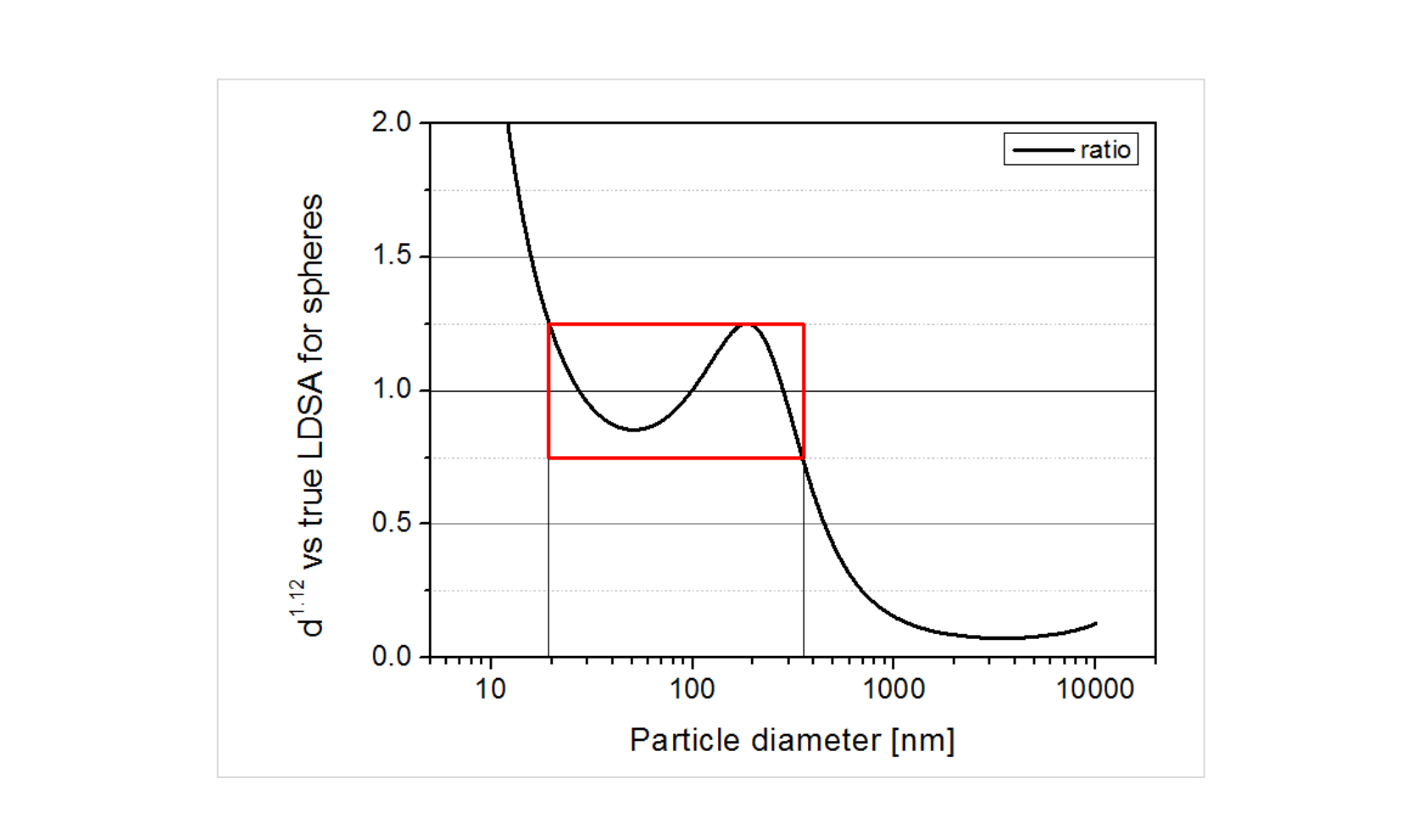
LDSA can be measured directly by diffusion charging. As can be seen in the lung deposition curve, particle deposition in the lower airways is approximately inversely proportional to the particle diameter in the diameter range of 20-300 nm. The LDSA is therefore approximately proportional to the signal from the diffusion charger, which makes it a good method for measuring ultrafine particles.