Measuring ultrafine particles

Measuring Ultrafine Particles

Ultrafine particles are attracting more and more attention,  particularly because of research into their harmfulness to health. Ultrafine particles (UFP) consist of extremely small particles suspended in the air and can originate from a wide range of sources. Long-term exposure to UFP can cause serious health problems, which is why we want to limit exposure. This text focuses on the most important aspects of ultrafine particles:

  • What are ultrafine particles? 
  • Why measure ultrafine particles?
  • Possible sources and exposure risks 
  • Legislation and standards
  • Measuring ultrafine particles

What are Ultrafine Particles?

Ultrafine particles are airborne particles smaller than 0.1 micrometre (μm), or 100 nanometres. The international abbreviation 'UFP' (Ultra Fine Particles) is also frequently used. Ultrafine particles are even smaller than the 'traditional particulate matter' that is usually measured (typically 0.1 to 10 micrometres in size, such as PM1, PM2.5 and PM10). Ultrafine dust is a collective term for a mixture of particles of varying origin and composition. Important constituents are elemental carbon (EC), metals, organic carbon compounds (OC) and sulphur compounds. The composition of ultrafine particles depends on the source. Near road traffic we find relatively high levels of elemental carbon, in wooded areas relatively high levels of organic carbon, and in the vicinity of airports relatively high levels of sulphurous compounds (because of the high sulphur content of kerosene). What makes ultrafine particles worrying is that these very small particles can penetrate deep into the lungs and can even enter the bloodstream. For more background knowledge about ultrafine dust we recommend the background document on exposure to ultrafine particles published by the Dutch Health Council.

Sources of ultrafine particles (UFP)

Ultrafine particles can come from both natural and man-made sources. Natural sources of ultrafine particles include forest fires, volcanic activity, and sea salt aerosols generated by waves at sea. These natural sources can release ultrafine particles into the atmosphere, but their contribution is generally smaller compared with man-made sources. Below are a number of important man-made sources of ultrafine particles:

  • Combustion processes

    Road traffic: Ultrafine particles from traffic refers to the small particles emitted by vehicles such as cars, lorries, buses, motorcycles and aircraft. Ultrafine dust from traffic is considered a major source of air pollution in urban areas. Diesel vehicles are known to produce more ultrafine dust than petrol vehicles because of the nature of the combustion and the particulate filters used on petrol vehicles. Wear of vehicle tyres and brakes may also contribute to ultrafine particle concentrations in the air. Ultrafine particles from traffic are, logically, mainly found in the immediate vicinity of busy roads and in urban areas with heavy traffic. People who live or work alongside busy roads are often exposed to higher levels of ultrafine particles. Inside vehicles too, passengers can be exposed to high levels of ultrafine particles, especially in traffic jams.

    Air traffic
    : Every type of engine (turbine, diesel, petrol) has a unique combustion process, which affects the size of the particles emitted. Ultrafine particles from air traffic are even smaller than those from road traffic. In addition, ultrafine particles from road traffic are far more mixed with other substances such as soot. Just as with car combustion engines, ultrafine particles are also released from aircraft combustion engines. Ultrafine particles are released during the burning of kerosene, mainly during take-off and landing. According to one study, ultrafine particle concentrations from air traffic in the area around Schiphol are between 10,000 and 30,000 particles/cm3. Outside this area, for example in Leiden or Purmerend, the average concentration is considerably lower, between 500 and 1000 particles per cm3. (Source: RIVM)

    Industrial combustion:
    Industrial processes such as power generation, steel production, cement production and waste incineration can generate considerable quantities of ultrafine dust by burning fossil fuels or other materials that release particles into the air. Power generation often involves burning fossil fuels (such as coal, natural gas or oil). During this combustion process small particles, including ultrafine particles, are emitted as a result of incomplete combustion.

    Industrial processes such as steel and cement production can cause specific ultrafine particle emissions. In steel production, for example, metallurgical dust particles may form during certain melting and casting processes. In cement production, the grinding of raw materials and the heating of materials can lead to the formation of ultrafine dust particles.

    Waste incineration plants burn waste materials to generate energy. During this process various reactions can occur that generate ultrafine particles, depending largely on the nature of the waste being burned. Little research has yet been carried out into actual ultrafine dust emissions and exposure in industry.

  • Nanotechnology: Nanotechnology refers to the branch of science concerned with designing, producing and using structures, devices and systems by manipulating atoms and molecules at the nanoscale. The applications of nanotechnology can be highly beneficial. However, research laboratories where nano product development takes place have an increased risk of exposure to ultrafine dust, since manipulation at the nanoscale can lead to ultrafine particles being released into the air.

Dangers of ultrafine particles

The smaller the dust particles, the deeper they can penetrate into your lungs and cause damage. In addition to damaging the lungs, ultrafine particles can even enter your bloodstream and cause cardiovascular disease. In recent years extensive research has been carried out into the relationship between ultrafine particles in outdoor air and health. There is growing evidence that long-term exposure to ultrafine particles has a negative influence on health, particularly on the airways, the heart and blood vessels, and the development and growth of the foetus.

To date there is no evidence that the health effects of ultrafine particles from aviation differ from the health effects of ultrafine particles from road traffic. A study by RIVM into the long-term effects of exposure to ultrafine particles from air traffic is currently still under way.

Source: (Gezondheidsraad, RIVM)

Legislation and guidelines 

As with particulate matter of larger particle sizes, a distinction can be made for ultrafine particles between exposure in the workplace and exposure in outdoor air. Workplace exposure always falls under the Dutch Working Conditions Act (Arbowet), for which the employer is responsible. However, an employer is not responsible for the background exposure to ultrafine particles present in that area.

Ultrafine particle exposure in the workplace

As briefly mentioned, exposure to ultrafine particles in the workplace is the employer's responsibility. There are no public/statutory limit values for ultrafine particles in the Netherlands. FNV and VNO-NCW have published a  ‘Guide to working safely with nanomaterials and products ’. The guide is intended as a tool for the risk inventory & evaluation (RI&E) focused on working with nanomaterials. With exposure to ultrafine particles there is the practical problem that the harmfulness/toxicity is not yet well understood. But there are strong indications that exposure leads to harmful effects. They therefore recommend working with the rule of thumb: Risk    =    Hazard    x    Exposure

The Naneos Partector 2 calculates the LDSA value and indicates on the screen, using traffic-light colours, which category the exposure falls into (according to the best available knowledge). With regard to the health disadvantages caused by ultrafine particles, this is more accurate than measuring a quantity of dust per unit of air volume (for example: mg/m³), as explained in the next paragraph.

Background exposure in outdoor air

There is (as yet) no (binding) standard for measuring ultrafine particles in outdoor air. Since March 2020, however, there has been a European standard for measuring the particle size distribution (with SMPS) (EN-17434). This standard prescribes how particle sizes between 10 and 800 nm must be measured with a Mobility Particle Size Spectrometer. A new directive that includes ultrafine particles is also under development. In it they are referred to as “one of the unregulated air pollutants of emerging concern”. The proposal in the draft directive is to start measuring UFP at a number of so-called supersites. A decision on the new directive is expected in 2024.


Measuring ultrafine particles

Particulate matter can be measured in various ways. Traditionally the particle mass per unit of air volume is measured, as is the case with PM10, PM2.5 and PM1 for example. Alternative parameters are, for instance, the number of particles, or the surface area of the particles per unit of volume. There is no such thing as the "best" measuring technique to use - it always depends on the application or the question you want to answer.

With regard to the health disadvantages caused by ultrafine particles, it can be argued that the traditional reporting of a quantity of dust per unit of air volume (for example: mg/m³) is not very meaningful. Only the particles that end up in the human body can cause health effects, so that is what should be measured when we measure ultrafine particles. The deposition fraction as a function of particle size for three different regions of our airways is shown in the figure below.
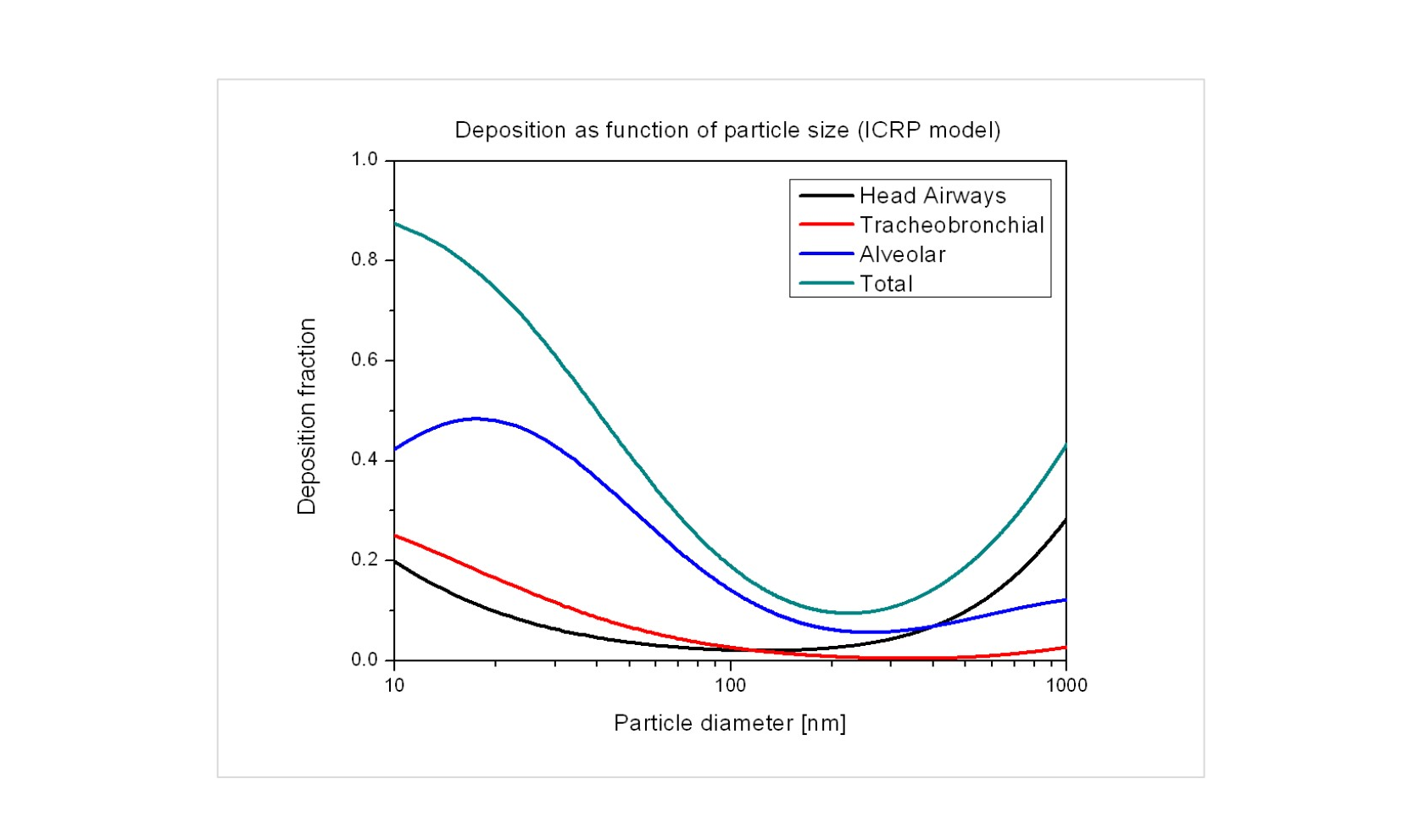
Basystemen Blogs Afbeeldingen Ultrafijnstof Meten (2)

Total deposition shows a clear minimum around 200-300 nm, where only ~10% of the particles present in the air end up in our body, whereas at a diameter of 40 nm roughly half of the particles end up in our body. On a mass basis, a single 200 nm particle (with a density of 1, spherical) is 125x heavier than a comparable 40 nm particle and contributes 125 times more to the measured PMx, although it contributes "only" 20 times more to the mass that ends up in the human body, because its deposition is far less likely. We can therefore conclude that - at least with regard to health effects - we should look only at deposited particles.

Various laboratory studies have shown that, on a mass basis, smaller particles appear to be more toxic than larger particles. This is explained by the larger surface area of the smaller particles; the particle surface is where our body interacts with the particles. Particles can transport absorbed toxins on their surface, or their surface can act as a catalyst within a cell, creating reactive oxygen species (ROS). It has been shown that the toxic effects scale well with particle surface area in both in-vitro and in-vivo experiments (details). We should therefore measure the surface area of particles deposited in the lungs (Lung Deposited Surface Area / LDSA), since this appears to be the most relevant physical measure for quantifying exposure to particles.

LDSA can be measured directly by diffusion charging. As can be seen in the lung deposition curve, particle deposition in the lower airways is approximately inversely proportional to the particle diameter in the diameter range of 20-300 nm. The LDSA is therefore approximately proportional to the signal from the diffusion charger, which makes it a good method for measuring ultrafine particles.
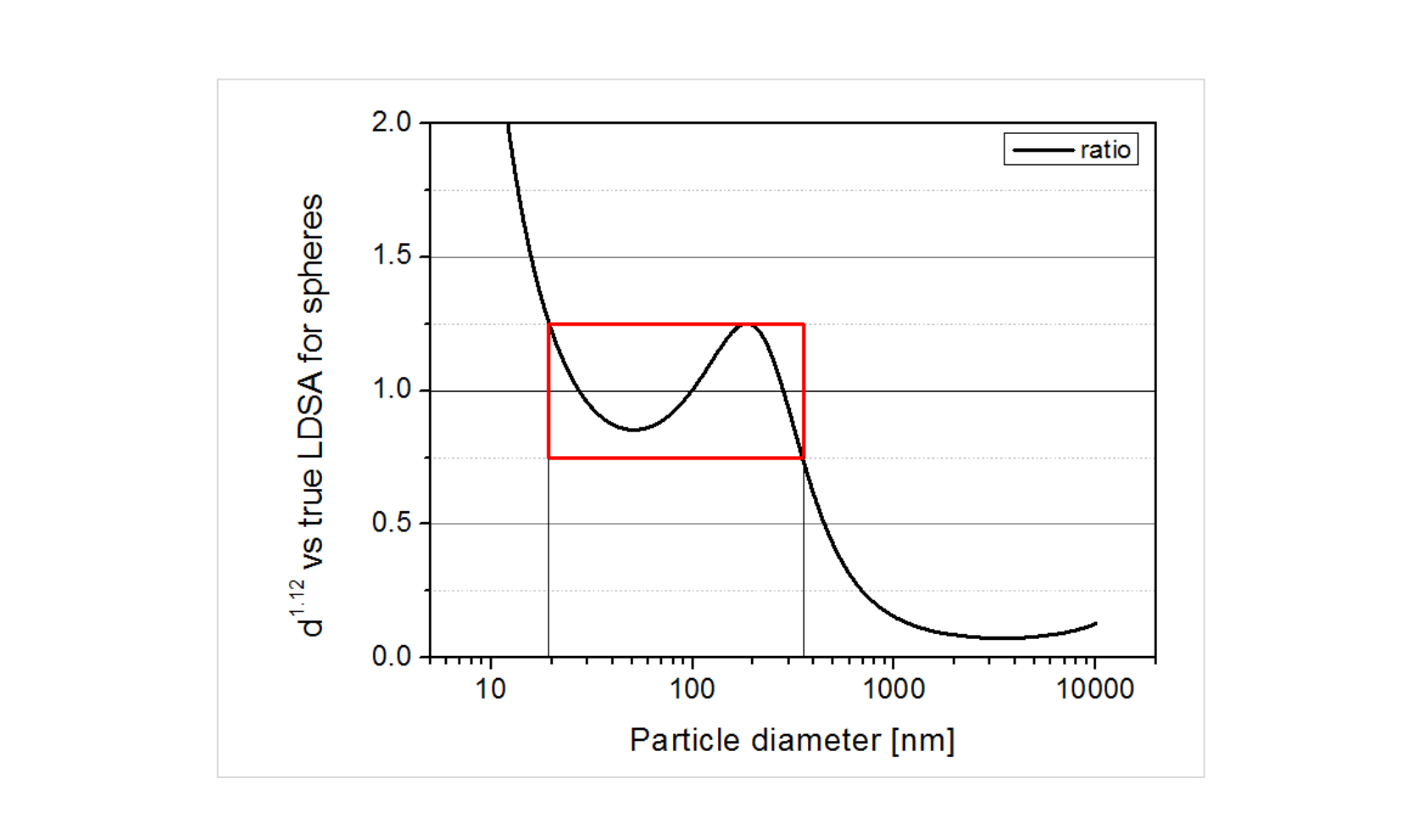
Basystemen Blogs Afbeeldingen Ultrafijnstof Meten LDSA Curve (1)

Measuring equipment for ultrafine particles

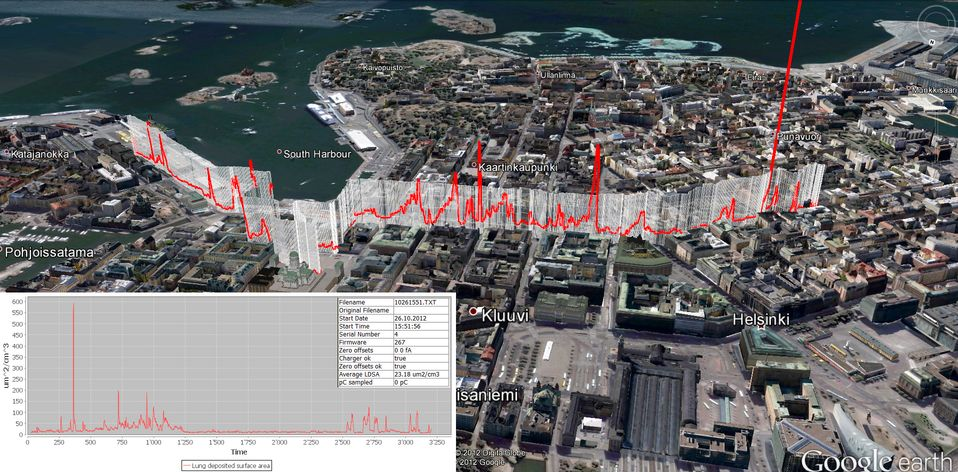
Using suitable measuring equipment is essential for measuring particulate matter and taking preventive measures. Ultrafine particles have a very low mass. That is why the Partector 2 displays health-relevant parameters such as the lung deposited surface area (LDSA), the number of particles, particle mass and particle diameter. This is useful for detecting the presence of ultrafine particles, checking air filters, or for a detailed analysis of ultrafine particles in outdoor air. Small, light and affordable - the Partector 2 is the ideal instrument for studies where nanoparticle concentrations need to be measured at high spatial resolution. By using several instruments simultaneously, you can measure transport phenomena and the distribution of particle concentration. By combining Partector 2 data with GPS data, you can easily visualise your measurements in Google Earth. The Naneos Partector series devices can stream data to a measurement data cloud to enable straightforward real-time data analysis and remote detection.

Basystemen Blogs Afbeeldingen Ultrafijnstof Meten Gps Grafiek Helsinki


  • Measuring the number of ultrafine particles

For particulate matter (PM0.1 - PM10) the weight in the air is measured. Measuring ultrafine particles works differently: the dust is so light that the number of particles in the air is measured instead. Data on the numbers of ultrafine particles is relevant to exposure (from an epidemiological point of view) in places where people spend time. 

  • Particle diameter

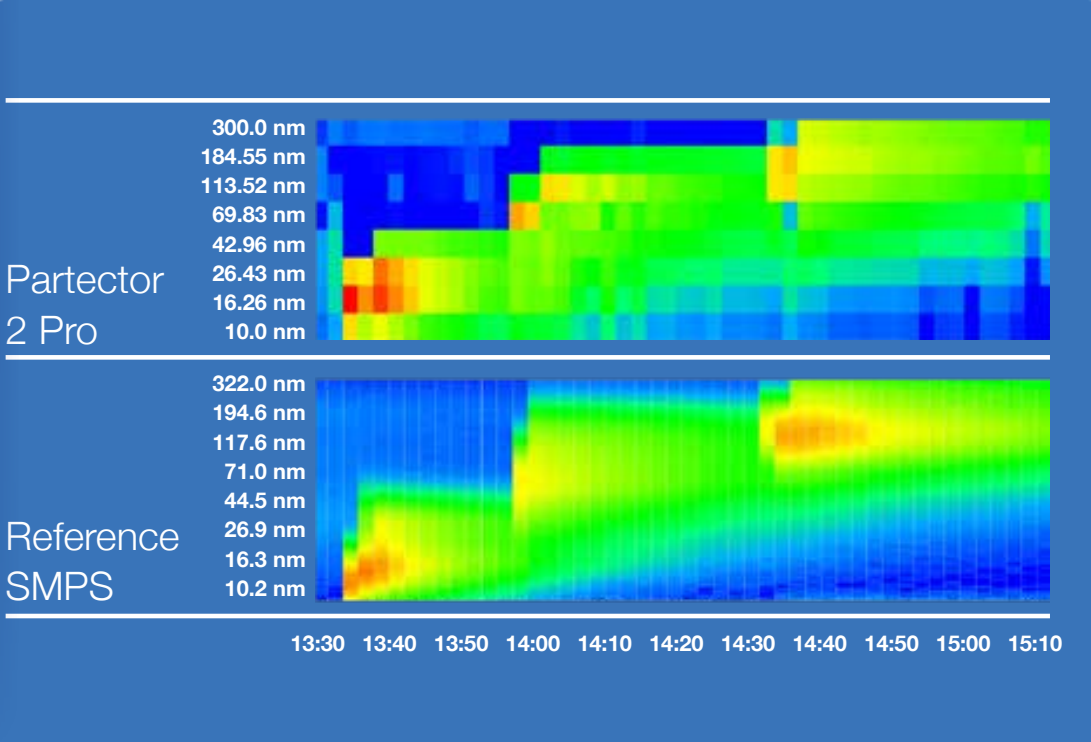
The ultrafine particle monitors in the Naneos Partector series measure particles with a particle size of 10 nm to 10 µm. The Partector 2 Pro even offers an additional eight-channel size distribution of ultrafine particle concentrations, as shown in the image below. 

Basystemen Blogs Afbeeldingen Ultrafijnstof Meten 8 Kanaals Partikeldistributie


Naneos Partector 2 Pro - Measuring Ultrafine Particles Made Easy 

The Naneos Partector 2 Pro is one of the smallest nanoparticle monitors in the world and can measure ultrafine particles in real time by means of diffusion charging. The Partector 2 Pro can measure particles from 10 nanometres to 10 micrometres. The instrument also offers data logging and analysis, allowing users to follow trends and gather important information for reporting and decision-making. Thanks to its compact format, the Naneos Partector 2 Pro is particularly suitable for personal exposure measurements, especially in view of the LDSA values collected. In addition, the device is also very suitable for source tracing, or it can be used to select suitable fixed measuring points in source-impacted areas. Finally, the Partector 2 can serve as a reference instrument that can be compared with measured values from fixed stations. An advantage of this is that a mobile ultrafine particle monitor can be calibrated more easily than a fixed set-up.

In short, measuring ultrafine particles in the air or in the workplace is of great importance to the health of the population and of employees.

For more information about measuring ultrafine particles or the Naneos Partector 2 Light, Naneos Partector 2 or Naneos Partector 2 Pro, please feel free to contact us!